接第一篇:
3 讨论
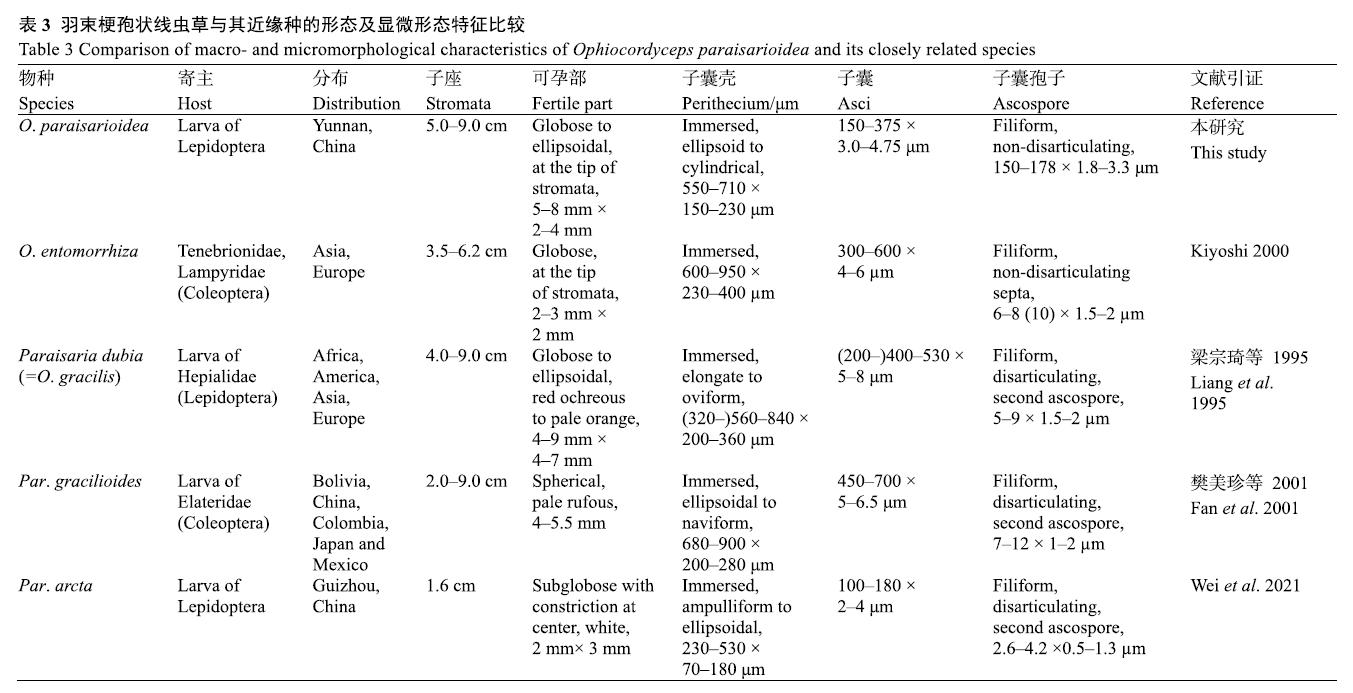
本文报道了一个线虫草属新物种,命名为羽束梗孢状线虫草,其与虫根线虫草在子座形态上均与Paraisaria 属物种相似,均在子座顶端产生球形可孕部,且子囊壳均为埋生(表3),容易误将羽束梗孢类群错误当成虫根线虫草(Kobayasi 1937;Pérez-Villamares et al. 2017)。从形态特征来看,Paraisaria 属物种子座颜色较浅,而羽束梗孢状线虫草与虫根线虫草通常子座偏深褐色,在球形可孕部上的子囊壳顶端通常形成小突起,而Paraisaria 相对平整。本物种与虫根线虫草相比,寄主类型、子座颜色和质地等均有显著区别。从5 基因系统发育树看,O. paraisarioidea、O. entomorrhiza 与Tilachlidiopsis nigra 位于线虫草属基部,形成一个独立的分支(basal clade)。另外,ITS 序列的系统发育结果也显示O. paraisarioidea和O. entomorrhiza 与O.ravenelii clade 有紧密的亲缘关系。我们的研究较好地补充了线虫草属基部分支类群的物种多样性。该类群可能代表了线虫草属早期演化过程中一类形态与寄主特征多样、系统位置关键类型,对深入理解线虫草属的起源与早期辐射具有重要意义。从地理分布看,O. entomorrhiza 分布于日本和欧洲,而本文报道的O. paraisarioidea 目前仅见分布于中国西南生物多样性热点地区——横断山区,可能横断山区复杂的地形地貌和多样的生态环境为线虫草属基部类群的分化和O. paraisarioidea 的物种形成提供了生态位基础,显示该区域在物种形成与适应中的重要作用。
分子系统发育已成为当下物种识别鉴定及系统发育重要的研究手段(James et al. 2006;Spatafora et al. 2006;Sung et al. 2007a;Yang & Rannala 2012),因此序列的有效性和完整性尤为关键。近年来,多基因系统发育逐渐取代单基因分析,成为线虫草属分类与系统发育研究的主流方法(Chen et al. 2013;Sanjuan et al. 2015;代永东 2018;Araújo & Hughes 2019;邹维秋 2022;Tang et al. 2023;杨涛 2023;Dai et al. 2024;周云 2024;Xu et al. 2025)。与单基因相比,多基因系统发育具备一定的容错能力,即允许部分基因缺失而不显著影响结果。本研究对多系统发育分析所用5 个基因的序列情况进行统计发现,不同基因存在不同程度的缺失(有效数据量:nrSSU 337、nrLSU 388、tef-1α 426、rpb1 401、rpb2 257),其中rpb2 缺失最为严重,达到46%(202/439)。本研究在开展O. paraisarioidea 的分子测序过程中,成功扩增了ITS、nrSSU、nrLSU、tef-1α 和rpb1 基因,但rpb2 基因可能由于引物特异性不足或与目标物种序列匹配度较低等原因,经过多标本多次扩增,仍未获得目标序列。在系统树构建过程中,我们将O. paraisarioidea的rpb2 基因标注为“missing data”,所得结果在主要分支上的支持度依然较高,且ML 和BI 两种分析方法所得拓扑结构一致,能够有效解析O. paraisarioidea 的系统发育位置,并为其分类地位提供可靠的分子证据。但是需要注意的是,数据缺失不可避免地会对系统发育分析结果产生影响,应尽量减少此类情况的发生。后续应该设计更具有针对性的特异性引物,以补充相关数据。
本研究在构建线虫草属系统发育关系时,将寄主类型映射至线虫草属系统发育树上(图1A),发现O. paraisarioidea 所属的线虫草属基部分支(Basel clade)及其近缘的O. ravenelii clade 的已知寄主均为鞘翅目昆虫[虽O. variabilis 寄主为双翅目食木虻幼虫,但与鞘翅目幼虫习性相似(Hodge et al. 1998)] , 而本研究报道的O. paraisarioidea 却以鳞翅目为寄主。这一“特例”打破了该分支对寄主类型的传统一致性,为Araújo & Hughes (2019)提出的“线虫草属以鞘翅目为祖先寄主”的假说提供了新的视角,提示这一观点或需进一步探讨。这一发现暗示线虫草属在早期演化过程中可能存在更为复杂或多次发生的寄主转换事件,或在特定生态环境下形成了对非典型寄主的适应能力。尤其是在中国横断山区这一生态多样性极高的区域,宿主可获得性和环境选择压力可能促成了物种对鳞翅目等其他昆虫类群的利用,进而推动其生态位扩展和系统发育分化。
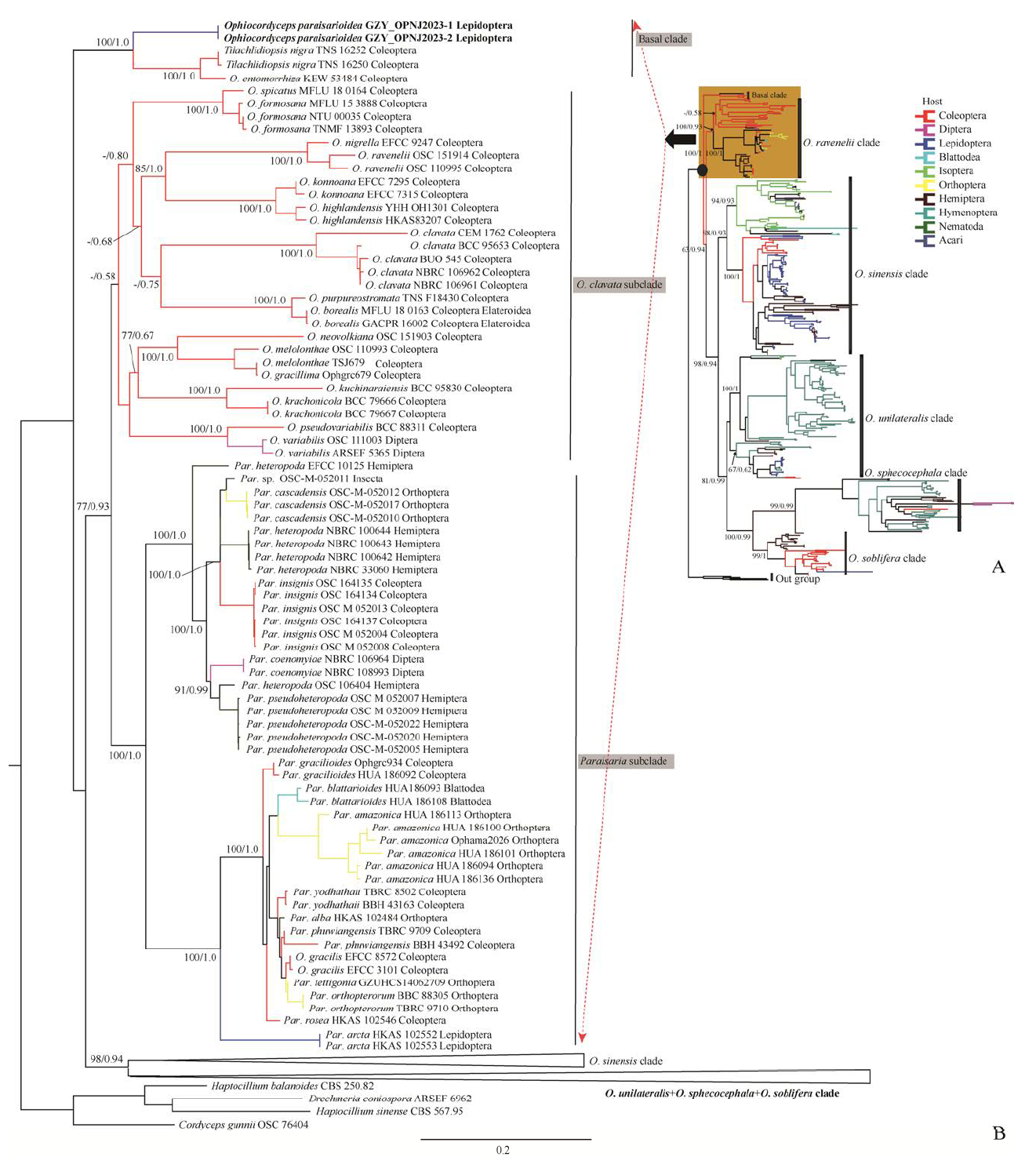
Paraisaria 是Samson & Brady (1983)根据Ophiocordyceps gracilis 的无性阶段特征即白色松散的束状孢梗束,轮生分枝的分生孢子梗,梗上具瓶状、以顶端增生方式繁殖的瓶梗,形成易聚集成孢子头状的单个透明的分生孢子而建立。Sung et al. (2007a)基于多基因系统发育研究将该属并入Ophiocordyceps 属中。随后,Mongkolsamrit et al. (2019)认为Paraisaria 在形态学上具有明显区别,且系统发育上形成一个相对独立且支持率较高的单系类群,因而将其从Ophiocordyceps 中恢复为独立属。然而,尽管Paraisaria 的形态特征具有较强的识别性,其属级地位在系统发育上仍缺乏充分支持,从本研究的结果来看,该类群位于O. ravenelii clade 分支内,且嵌套于Ophiocordyceps 属的系统发育框架之中(非单独分支)。因此目前尚不足以支持其作为一个独立属。当前Ophiocordyceps 属内界限与谱系关系仍存在争议,亟须依托更全面深入的数据、形态特征及生态信息进行综合解析,以推动该属系统分类的进一步厘清和优化。
作者贡献
常衬心:标本采集、实验设计与实施、数据分析、论文撰写;张忠霞:实验、数据分析;邓丽萍:数据分析、论文撰写、图片制作;梁建东:实验设计、数据分析、论文修改;俞琦:数据分析,论文审核与修改;代永东:论文构思、实验设计、数据分析、论文审核与修改。
利益冲突声明
该研究不存在任何潜在利益冲突的商业或财务关系。
[REFERENCES]
Araújo JPM, Hughes DP, 2019. Zombie-ant fungi emerged from non-manipulating, beetle-infecting ancestors. Current Biology, 29(21): 3735-3738
Bałazy S, 1982. Supplementary notes to the biology of Cordyceps entomorrhiza (Dicks. ex Fr.) Link and the morphology of its conidial stages. Acta Mycologica,18(2): 231-238
Ban S, Sakane T, Nakagiri A, 2015. Three new species of Ophiocordyceps and overview of anamorph types in the genus and the family Ophiocordyceptaceae. Mycological Progress, 14(1): 1017-1028
Bischoff JF, Refiner SA, Humher PA, 2006. Metarhizium frigidum sp. nov.: a cryptic species of M. anisopliae and a member of the M. flavoviride complex. Mycologia, 98(5): 73-745
Chen JY, Cao YQ, Yang DR, Li MH, 2011. A new species of Ophiocordyceps (Clavicipitaceae, Ascomycota) from southwestern China. Mycotaxon, 115: 1-4
Chen SQ, 2021. Phylogeny and comparative genomics of Ophiocordyceps crinalis and its relatives. PhD Dissertation, Yunnan University, Kunming. 1-176 (in Chinese)
Chen ZH, Dai YD, Yu H, Yang K, Yang ZL, Yuan F, Zeng WB, 2013. Systematic analyses of Ophiocordyceps lanpingensis sp. nov. a new species of Ophiocordyceps in China. Microbiological Research, 168: 525-532
Crous PW, Osieck ER, Shivas RG, et al. (more than 20 authors), 2023. Fungal Planet description sheets: 1478–1549. Persoonia, 50: 158-310
Dai YD, 2018. Taxonomy and biogeography of Ophiocordyceps sinensis and its allies in southeastern Qinghai-Xizang Plateau. PhD Dissertation, Yunnan University, Kunming. 1-159 (in Chinese)
Dai YD, Chen SQ, Wang YB, Wang Y, Yang ZL, Yu H, 2024. Molecular phylogenetics of the Ophiocordyceps sinensisspecies complex lineage (Ascomycota, Hypocreales), with the discovery of new species and predictions of species distribution. IMA Fungus, 15: 2
Dong CH, Liu XZ, Li ZZ, Yan WJ, Li TH, 2016. Cordyceps industry in China: current status, challenges and perspectives — Jinhu declaration for Cordyceps industry development. Mycosystema, 35(1): 1-15 (in Chinese)
Evans HC, Elliot SL, Hughes DP, 2011a. Ophiocordyceps unilateralis: a keystone species for unraveling ecosystem functioning and biodiversity of fungi in tropical forests? Communicative & Integrative Biology, 4: 598-602
Evans HC, Elliot SL, Hughes DP, 2011b. Hidden diversity behind the zombie-ant fungus, Ophiocordyceps unilateralis: four new species described from carpenter ants in Minas Gerais, Brazil. PLoS One, 6(3): e17024
Fan MZ, Li CR, Chen YY, Li ZZ, 2001. Cordyceps gracilioides, a new record for China. Mycosystema, 20(2): 273-274 (in Chinese)
Fan Q, Yang T, Li H, Wang XM, Liao HF, Shen PH, Yang ZL, Zeng WB, Wang YB, 2024. Molecular phylogeny and morphology reveal two new entomopathogenic species of Ophiocordyceps (Ophiocordycipitaceae, Hypocreales) parasitic on termites from China. MycoKeys, 103: 1-24
Hodge KT, Humber RA, Wozniak AC, 1998. Cordyceps variabilis and the genus Syngliocladium. Mycologia, 90(5): 743-753
James T, Kauff F, Schoch C, et al. (more than 20 authors), 2006. Reconstructing the early evolution of Fungi using a six-gene phylogeny. Nature, 443: 818-822
Kiyoshi I, 2000. Several additional occurrences of a rare entomogenous fungus Cordyceps entomorrhiza from Tokyo. Natural Environmental Science Research, 13: 121-125
Kobayasi Y, 1937. On the specific connection of Cordyceps entomorrhiza and Tilachlidiopsis nigra. The Botanical Magazine, 51(603): 97-102
Kobayasi Y, 1941. The genus Cordyceps and its allies. Science Reports, 5(1): 53-260
Kobayasi Y, 1982. Keys to the taxa of the genera Cordyceps and Torrubiella. Transactions of the Mycological Society of Japan, 23: 329-364
Lanfear R, Frandsen PB, Wright AM, Senfeld T, Calcott B, 2017. PartitionFinder 2: new methods for selecting partitioned models of evolution for molecular and morphological phylogenetic analyses. Molecular Biology and Evolution, 34(3): 772-773
Li GJ, Hyde KD, Zhao RL, et al. (more than 20 authors), 2016. Fungal diversity notes 253–366: taxonomic and phylogenetic contributions to fungal taxa. Fungal Diversity, 78(1): 1-237
Liang ZQ, 2007. Flora fungorun sinicorun: Vol 32. Cordyceps. Science Press, Beijing. 1-190 (in Chinese)
Liang ZQ, Liu AY, Fan MZ, Guo C, 1995. Several species of Cordyceps in northwest area, China. Acta Mycologica Sinica, 14(3): 237-240 (in Chinese)
Liu SF, 2004. Ecological studies on the nematophagous fungi Hirsutella minnesotensis and Hirsutella rhossiliensis. PhD Dissertation, Hebei Agricaltural University, Baoding. 1-145 (in Chinese)
Luangsa-Ard JJ, Tasanathai K, Thanakitpipattana D,Khonsanit A, Stadler M, 2018. Novel and interesting Ophiocordyceps spp. (Ophiocordycipitaceae, Hypocreales) with superficial perithecia from Thailand. Studies in Mycology, 89: 125-142
Mains EB, 1958. North American entomogenous species of Cordyceps. Mycologia, 50(2): 169-222
Mongkolsamrit S, Noisripoom W, Arnamnart N, Lamlertthon S, Himaman W, Jangsantear P, Samson RA, Luangsa-ard JJ, 2019. Resurrection of Paraisaria in the Ophiocordycipitaceae with three new species from Thailand. Mycological Progress, 18(9): 1213-1230
Mongkolsamrit S, Noisripoom W, Tasanathai K, Khonsanit A, Thanakitpipattana D, Lamlertthon S, Himaman W, Crous PW, Stadler M, Luangsa-Ard JJ, 2024. Uncovering cryptic species diversity of Ophiocordyceps (Ophiocordycipitaceae) associated with Coleoptera from Thailand. Fungal Systematics and Evolution, 14: 223-250
Pérez-Villamares JC, Burrola-Aguilar C, Aguilar-Miguel X, Sanjuan T, Jiménez-Sánchez E, 2017. New records of entomopathogenous fungi of the genus Cordyceps s. l. (Ascomycota: Hypocreales) from the State of México. Revista Mexicana de Biodiversidad, 88(4): 773-783
Petch T, 1931. Notes on entomogenous fungi. Transactions of the British Mycological Society, 16: 55-75
Quandt CA, Kepler RM, Gams W, Araújo JPM, Ban S, Evans HC, Hughes D, Humber R, Hywel-Jones NL, Li ZZ, Luangsa-ard JJ, Rehner SA, Sanjuan T, Sato H, Shrestha B, Sung GH, Yao YJ, Zare R, Spatafora JW, 2014. Phylogenetic-based nomenclatural proposals for Ophiocordycipitaceae (Hypocreales) with new combinations in Tolypocladium. IMA Fungus, 5(1): 121-134
Rath AC, 2000. The use of entomopathogenic fungi for control of termites. Biocontrol Science and Technology, 10(5): 563-581
Ronquist F, Teslenko M, van der Mark ADL, Darling A, Höhna S, Larget B, Liu L, Suchard MA, Huelsenbeck JP, 2012. MrBayes 3.2: efficient bayesian phylogenetic inference and model choice across a large model space. Systematic Biology, 61: 539-542
Samson RA, Brady BL, 1983. Paraisaria, a new genus for Isaria dubia, the anamorph of Cordyceps gracilis. Transactions of the British Mycological Society, 81(2):285-290
Sanjuan T, Francomolano AE, Kepler RM, Spatafora JW,Tabima J, Vasco-Palacios AM, Restrepo S, 2015. Five new species of entomopathogenic fungi from the Amazon and evolution of neotropical Ophiocordyceps. Fungal Biology, 119(10): 901-916
Shrestha B, Tanaka E, Hyun MW, Han JG, Kim CS, Jo JW, Han SK, Oh J, Sung GH, 2016. Coleopteran and Lepidopteran hosts of the entomopathogenic genus Cordyceps sensu lato. Journal of Mycology, 2: 1-14
Spatafora JW, Sung GH, Johnson D, et al. (more than 20 authors), 2006. A five-gene phylogeny of Pezizomycotina. Mycologia, 98(6): 1018-1028
Spatafora JW, Sung GH, Sung JM, Hywel-Jones NL, White JF, 2007. Phylogenetic evidence for an animal pathogen origin of ergot and the grass endophytes. Molecular Ecology, 16(8): 1701-1711
Stamatakis A, 2006. RAxML-VI-HPC: maximum likelihoodbased phylogenetic analyses with thousands of taxa and mixed models. Bioinformatics, 22(21): 2688-2690
Sun T, Chen Y, Wang D, Dai YD, Zou WQ, Luo R, Dong QY, Yu H, 2024. Mitogenomics, phylogeny and morphology reveal two new entomopathogenic species of Ophiocordyceps (Ophiocordycipitaceae, Hypocreales) from south-western China. MycoKeys, 109: 49-72
Sun T, Zou WQ, Dong QY, Huang O, Tang DX, Yu H, 2022. Morphology, phylogeny, mitogenomics and metagenomics reveal a new entomopathogenic fungus Ophiocordyceps nujiangensis (Hypocreales, Ophiocordycipitaceae) from southwestern China. MycoKeys, 94: 91-108
Sung GH, Hywel-Jones NL, Sung JM, Luangsa-Ard JJ, Shrestha B, Spatafora JW, 2007a. Phylogenetic classification of Cordyceps and the clavicipitaceous fungi. Studies in Mycology, 57: 5-59
Sung GH, Sung JM, Hywel-Jones NL, Spatafora JW, 2007b. A multi-gene phylogeny of Clavicipitaceae (Ascomycota, Fungi): identification of localized incongruence using a combinational bootstrap approach. Molecular Phylogenetics and Evolution, 44(3): 1204-1223
Tamura K, Peterson D, Peterson N, Stecher G, Nei M, Kumar S, 2011. MEGA5: molecular evolutionary genetics analysis using maximum likelihood, evolutionary distance, and maximum parsimony methods. Molecular Biology and Evolution, 28: 2731-2739
Tang DX, Huang O, Zou WQ, Wang YB, Wang Y, Dong QY, Sun T, Yang G, Yu H, 2023. Six new species of zombie-ant fungi from Yunnan in China. IMA Fungus, 14(1): 9
Tehan RM, Dooley CB, Barge EG, McPhail KL, Spatafora JW, 2023. New species and new combinations in the genus Paraisaria (Hypocreales, Ophiocordycipitaceae) from the U.S.A, supported by polyphasic analysis. MycoKeys, 100: 69-94
Thanakitpipattana D, Tasanathai K, Mongkolsamrit S, Khonsanit A, Lamlertthon S, Luangsa-Ard JJ, 2020. Fungal pathogens occurring on Orthopterida in Thailand. Persoonia, 44: 140-160
Vilgalys R, Hester M, 1990. Rapid genetic identification and mapping of enzymatically amplified ribosomal DNA from several Cryptococcus species. Journal of Bacteriology, 172(8): 4238-4246
Wang Y, Dai YD, Yang ZL, Guo R, Wang YB, Zhu LY, Ding L, Yu H, 2021. Morphological and molecular phylogenetic data of the Chinese medicinal fungus Cordyceps liangshanensis reveal its new systematic position in the family Ophiocordycipitaceae. Mycobiology, 9: 1-11
Wang YB, Yu H, Dai YD, Wu CK, Zeng WB, Yuan F, Liang ZQ, 2015. Polycephalomyces agaricus, a new hyperparasite of Ophiocordyceps sp. infecting melolonthid larvae in southwestern China. Mycological Progress, 14: 70
Wang YW, Hong TW, Tai YL, Wang YJ, Tsai SH, Lien PT, Chou TH, Lai JY, Chu R, Ding ST, Irie K, Li TK, Tzean SS, Shen TL, 2015. Evaluation of an Epitypified Ophiocordyceps formosana (Cordyceps s.l.) for its pharmacological potential. Evidence-based Complementary and Alternative Medicine, 2015: 189891
Wei DP, Wanasinghe DN, Xu JC, To-Anun C, Mortimer PE, Hyde KD, Elgorban AM, Madawala S, Suwannarach N, Karunarathna SC, Tibpromma S, Lumyong S, 2021.Three novel entomopathogenic fungi from China and Thailand. Frontiers in Microbiology, 11: 608991
Wen TC, Xiao YP, Zha LS, Hyde KD, Kang JC, 2016. Multigene phylogeny and morphology reveal a new species, Ophiocordyceps tettigonia, from Guizhou Province, China. Phytotaxa, 280(2): 141
White TJ, Bruns T, Lee S, Taylor JW, 1990. Amplification and direct sequencing of fungal ribosomal RNA genes for phylogenetics. In: Innis MA, Gelfand DH, Sninsky JJ, White TJ (eds.) PCR protocols: a guide to methods and applications. Academic Press, New York. 315-322
Will L, Das B, Trinh T, Brachmann A, Ohm RA, de Bekker C, 2020. Genetic underpinnings of host manipulation by Ophiocordyceps as revealed by comparative transcriptomics. Genes Genomes Genetics, 10: 2275-2296
Wu F, Zhou LW, Yang ZL, Bau T, Li TH, Dai YC, 2019. Resource diversity of Chinese macrofungi: edible, medicinal and poisonous species. Fungal Diversity, 98: 1-76
Xu ZS, Deng LP, Wang HY, Tian HL, Qu JJ, Dai YD, Zou X, 2025. Description of two new species of Ophiocordyceps: O. sinocampes and O. cystidiata (Ophiocordycipitaceae,Hypocreales) from typical karst landform forests in Guizhou, China. Mycokeys, 114: 1-27
Yang T, 2023. Taxonomy and multigene phylogeny of Ophiocordyceps from China. MS Thesis, Yunnan University, Kunming. 1-175 (in Chinese)
Yang ZH, Rannala B, 2012. Molecular phylogenetics: principles and practice. Nature Reviews Genetics, 13: 303-314
Yang ZL, Qin J, Xia C, Hu Q, Li QQ, 2015. Ophiocordyceps highlandensis, a new entomopathogenic fungus from Yunnan, China. Phytotaxa, 204(4): 287-295
Ye X, Suo FY, Lu S, Wang Z, 2015. Effect of Ophiocordyceps gracilis extract on the proliferation of AGS gastric cancer cells. Acta Edulis Fungi, 22(2): 51-54 (in Chinese)
Yu D, Chen L, Guo JL, 2010. A review of research on Cordyceps liangshanensis. Lishizhen Medicine and Materia Medica Research, 21(8): 2024-2025, 2027 (in Chinese)
Yu H, 2016. Cordyceps resources and utilization in Yunnan — the kingdom of Cordyceps in Yunnan. Nanhua (China) Wild Mushroom Conference, Nanhua. 21-22 (in Chinese)
Zang M, Liu DQ, Hu RY, 1982. Notes concerning the subdivisions of Cordyceps and a new species from China. Acta Botanica Yunanica, 4(2): 173-176 (in Chinese)
Zha LS, Kryukov VY, Ding JH, Jeewon R, Chomnunti P, 2021. Novel taxa and species diversity of cordyceps sensu lato (hypocreales, ascomycota) developing on wireworms (elateroidea and tenebrionoidea, coleoptera). MycoKeys, 78(2): 79-117
Zha LS, Ye L, Huang SK, Boonmee S, Eungwanichayapant PD, Hyde KD, Wen TC, 2020. Species diversity and host associations of Cordyceps (Hypocreales) parasitic on Orthoptera insects. Mycosystema, 39(4): 707-722
Zheng B, Xie FY, Cai GH, Zhu RC, Li K, Gao SQ, Tan DB, Hao XY, Qin YH, 2015. Effects of Ophiocordyceps xuefengensis on proliferation of DC-CIK cells and activity of killing HepG-2 cells by DC-CIK cells. Chinese Journal of Immunology, 31(2): 189-192 (in Chinese)
Zhou SB, 2021. Ophiocordyceps lanpingensis polysaccharides combined with cisplatin to enhance the antitumor activity of Lewis tumor-bearing mice. MS Thesis, Kunming University of Science and Technology, Kunming. 1-75(in Chinese)
Zhou Y, 2024. Species diversity of Ophiocordycipitaceae in Yunnan and bioactive compounds of Tolypocladium tengchongensis. MS Thesis, Guizhou University, Guiyang.1-105 (in Chinese)
Zou WQ, 2022. Taxonomy and multigene phylogeny of Ophiocordyceps from Yunnan. MS Thesis, Yunnan University, Kunming. 1-122 (in Chinese)
[附中文参考文献]
陈思琪,2021. 发丝线虫草及其近缘种系统发育与比较基因组学研究. 云南大学博士论文,昆明. 1-176
代永东,2018. 青藏高原东南部冬虫夏草及其近缘种分类与谱系地理研究. 云南大学博士论文,昆明. 1-159
董彩虹,刘杏忠,李增智,闫文娟,李泰辉,2016. 我国虫草产业发展现状、问题及展望—虫草产业发展金湖宣言. 菌物学报,35(1): 1-15
樊美珍,李春如,陈远友,李增智,2001. 虫草属一新纪录种—拟细虫草. 菌物系统,20(2): 273-274
梁宗琦,2007. 中国真菌志. 第三十二卷,虫草属. 北京:科学出版社. 1-190
梁宗琦,刘爱英,樊美珍,郭超,1995. 西北地区的几种虫草. 真菌学报,14(3): 237-240
刘淑芬,2004. 食线虫真菌Hirsutella minnesotensis 和 Hirsutella rhossiliensis 的生态学研究. 河北农业大学博士论文,保定. 1-145
杨涛,2023. 中国线虫草属物种分类与多基因系统发育研究. 云南大学硕士论文,昆明. 1-175
叶星,索菲娅,卢帅,王卓,2015. 新疆细虫草提取物对胃癌AGS 细胞增殖的影响. 食用菌学报,22(2): 51-54
喻东,陈璐,国锦琳,2010. 凉山虫草的研究综述. 时珍国医国药,21(8): 2024-2025, 2027
虞泓,2016. 云南虫草资源及利用——虫草王国在云南.2016 中国南华野生菌大会资料汇编,南华. 21-22
臧穆,刘道庆,胡若英,1982. 中国虫草属亚属的划分及新种报道. 云南植物研究,4(2): 173-176
郑兵,谢芳一,蔡国辉,朱如彩,李柯,高守泉,谭电波,郝晓勇,秦裕辉,2015. 雪峰虫草对DC-CIK 增殖及HepG-2 细胞杀伤作用的实验研究. 中国免疫学
杂志,31(2): 189-192
周树波,2021. 兰坪虫草多糖联合顺铂增强Lewis 荷瘤小鼠的抗肿瘤活性研究. 昆明理工大学硕士论文,昆明.1-75
周云,2024. 云南线虫草科物种多样性及Tolypocladium tengchongensis 活性成分研究. 贵州大学硕士论文,贵阳. 1-105
邹维秋,2022. 云南线虫草属物种分类与系统发育研究.云南大学硕士论文,昆明. 1-122