寄生鳞翅目幼虫的线虫草属一新种:羽束梗孢状线虫草
常衬心1,张忠霞2,邓丽萍2,梁建东1,俞琦1*,代永东1,2*
1 贵州中医药大学基础医学院/菌物药研究中心,贵州 贵阳 550025
2 贵州中医药大学药学院,贵州 贵阳 550025
摘 要:线虫草属Ophiocordyceps 是虫草类真菌中一个物种丰富、分布广泛、寄主多样的重要大属,目前已报道物种超过400 种。中国西南的云南横断山区是生物多样性热点地区,也是该属多样性的重要集中分布区。本研究在云南兰坪县采集到一线虫草标本,结合形态特征、ITS 序列及联合5 基因(nrSSU、nrLSU、tef-1α、rpb1 和rpb2)系统发育分析,确定该物种为线虫草属一新种,命名为羽束梗孢状线虫草Ophiocordyceps paraisarioidea sp. nov.。该种子座结构容易被误认为是Paraisaria 属物种,但表现出更深的子座色泽、顶端具小突起的球形可孕部,以及不断裂的多隔梭形子囊孢子。5 基因系统发育结果显示,该种与虫根线虫草Ophiocordyceps entomorrhiza 聚为一支,位于线虫草属的进化枝基部(basal clade),但二者在形态和寄主选择上存在显著差异:O.paraisarioidea 子座深棕色,顶端灰白,寄主为鳞翅目蛾类幼虫;而 O. entomorrhiza 子座偏黑,寄主为鞘翅目步甲属幼虫及成虫。形态比较和5 基因系统发育结果表明本文报道的O. paraisarioidea是线虫草属进化枝基部类群的一新物种,丰富了该分支物种多样性。此外,O. paraisarioidea 以鳞翅目昆虫为寄主的特征,拓宽了线虫草属基部类群物种寄主范畴,提示“线虫草属以鞘翅目为祖先寄主” 这一观点或需进一步探讨, 暗示该属在早期演化过程中可能经历了寄主转换。O.paraisarioidea 的发现对深入理解线虫草属的起源与早期辐射具有重要意义。
关键词:横断山区;多基因系统发育;线虫草属基部分支;球形可孕部;寄主转换;新种
[引用本文]
常衬心,张忠霞,邓丽萍,梁建东,俞琦,代永东,2026. 寄生鳞翅目幼虫的线虫草属一新种:羽束梗孢状线虫草. 菌物学报,45(1): 250213
Chang CX, Zhang ZX, Deng LP, Liang JD, Yu Q, Dai YD, 2026. Ophiocordyceps paraisarioidea sp. nov. (Hypocreales,Ophiocordycipitaceae), a novel species of Ophiocordyceps parasitizing lepidopteran larvae. Mycosystema, 45(1): 250213
资助项目:国家自然科学基金(32160005);贵州省微生物组与传染性疾病防控重点实验室(ZDSYS[2023]004)
This work was supported by the National Natural Science Foundation of China (32160005) and the Guizhou Key Laboratory of Microbiome and Infectious Disease Prevention & Control (ZDSYS[2023]004).
*Corresponding authors. E-mails: DAI Yongdong, yddai130@gzy.edu.cn; YU Qi, 756128099@qq.com
Received: 2025-07-14; Accepted: 2025-08-19
Ophiocordyceps paraisarioidea sp. nov. (Hypocreales, Ophiocordycipitaceae), a novel species of Ophiocordyceps parasitizing lepidopteran larvae
CHANG Chenxin1, ZHANG Zhongxia2, DENG Liping2, LIANG Jiandong1, YU Qi1*,DAI Yongdong1,2*
1 Fungus Medicine Research Center/ School of Basic Medical Science, Guizhou University of Traditional Chinese Medicine, Guiyang 550025, Guizhou, China
2 School of Pharmacy, Guizhou University of Traditional Chinese Medicine, Guiyang 550025, Guizhou, China
Abstract: Ophiocordyceps is a diverse, widely distributed, and host-rich genus of entomogenous fungi, with over 400 species reported to date. The Hengduan Mountains in Yunnan of southwestern China, recognized as a global biodiversity hotspot, represent a major center of diversity for this genus. In this study, we describe a new species of Ophiocordyceps from Hengduan Mountains in Yunnan, designated Ophiocordyceps paraisarioidea sp. nov., based on morphological observations and phylogenetic analyses using both single ITS sequences and a combined dataset of five loci (nrSSU, nrLSU, tef-1α, rpb1 and rpb2). Morphologically, this species is prone to misclassification as Paraisaria in virtue of stromatal structure, but it differs by having darker stromata, a spherical fertile part with apical protuberances, and multiseptate non-disarticulating ascospores. Five-gene phylogenetic analyses place O. paraisarioidea in the basal clade of Ophiocordyceps, clustering with Ophiocordyceps entomorrhiza. Nevertheless, the two species exhibit notable differences in morphology and host preference: O. paraisarioidea has dark brown stroma with grayish-white tips and parasitizes lepidopteran larvae, whereas O. entomorrhiza forms nearly black stromata and infects both larvae and adults of coleopteran insects (Carabus sp.). Notably, the lepidopteran host of O. paraisarioidea challenges the prevailing hypothesis that Coleopterans represent the ancestral hosts of Ophiocordyceps, implying the occurrence of multiple host shifts during the early evolutionary history. The discovery of O. paraisarioidea may provide valuable insight into the origin and early diversification of this genus.
Keywords: Hengduan Mountains; multigene phylogeny; the basal clade of Ophiocordyceps; spherical fertile part; host shift; new species
线虫草属Ophiocordyceps Petch 是虫草类真菌(cordycepitoid fungi)中关注度非常高的大属。目前已报道400 余种( 含Hirsutella Pat. 、Hymenostilbe Petch 和Paraisaria Samson & B.L. Brady) (http://www.indexfungorum.org)。线虫草属最初是Petch (1931)根据Ophiocordyceps blattae (Petch) Petch、O. unilateralis (Tul. & C. Tul.) Petch、O. peltata (Wakef.) Petch 和O. rhizoidea (Höhn.) Petch 这4 个物种而创建,定义其主要特征为不断裂的子囊孢子,以及顶端加厚的棒状子囊等。但Kobayasi (1941, 1982)、Mains (1958)、臧穆等(1982)均将Ophiocordyceps 作为亚属处理 (Cordyceps subg. Ophiocordyceps)。Sung et al. (2007a)基于nrSSU、nrLSU、tef-1α 等7 基因分子系统学研究,在线虫草科Ophiocordycipitaceae G.H. Sung, J.M. Sung, Hywel-Jones & Spatafora内重新确认线虫草属作为一个独立属的分类群特征,并强调该属区别于其他类群的显著特征是子座颜色较深或鲜艳,其质地柔韧或坚硬,细丝状或纤维状,并将其定为线虫草科的模式属。
线虫草物种分布广泛,在亚洲、欧洲、大洋洲、北美洲和南美洲等地均有大量报道,是一个世界性的广布属。它们的寄主范围丰富,包括鳞翅目、膜翅目、鞘翅目、半翅目、双翅目、蜚蠊目、脉翅目和蜻蜓目等,从幼虫、蛹、若虫到成虫的不同生命周期阶段,呈现出极其丰富的物种多样性和寄主多样性(Kobayasi 1982;Sung et al. 2007a;Evans et al. 2011a;Sanjuan et al. 2015;Shrestha et al. 2016;Luangsa-Ard et al. 2018; Araújo & Hughes 2019;Zha et al. 2020;Tang et al. 2023;Dai et al. 2024;Fan et al. 2024;Xu et al. 2025)。
线虫草属物种具有丰富的应用价值。该属中冬虫夏草Ophiocordyceps sinensis (Berk.) G.H.Sung et al.是中国著名的传统中药材,在营养、保健和疾病治疗中有重要应用价值(梁宗琦2007;董彩虹等 2016)。此外,雪峰线虫草 Ophiocordyceps xuefengensis T.C. Wen et al.、凉山线虫草O. liangshanensis (M. Zang, D.Q. Liu & R.Y. Hu) Hong Yu et al.、兰坪线虫草O. lanpingensis Hong Yu & Zi H. Chen、细虫草O. gracilis (Grev.) G.H. Sung et al.等,均具有良好的抗菌、抗肿瘤和抗病毒药理活性(喻东等 2010;叶星等 2015;郑兵等 2015;Wu et al. 2019;周树波 2021)。该属单侧生虫草复合群Ophiocordyceps unilateralis sensu lato 感染蚂蚁后可操纵寄主,使蚂蚁失去自主行为如同“僵尸”一般,亦称为“僵尸蚂蚁真菌”(Evans et al. 2011b)。该类群是一类极具“操纵模型”代表的真菌资源,他们对蚂蚁特异性的操纵能力使其成为研究寄主特异性的良好模型(Will et al. 2020)。另外, 线虫草属中 Hirsutella minnesotensis Sen Y. Chen, Xing Z. Liu & F.J. Chen、H. rhossiliensis Minter & Brady 和H. vermicola M.C. Xiang & Xing Z. Liu 是大豆线虫主要生防真菌(刘淑芬 2004),是农业害虫白蚁潜在的生防菌(Rath 2000)。
中国云南省拥有多样的生态环境和丰富的植被类型,是名副其实的“生物多样性王国”。该地区报道大量线虫草物种(代永东 2018;陈思琪 2021;邹维秋 2022;杨涛 2023;Dai et al. 2024;周云 2024),有“虫草王国”的美誉(虞泓 2016)。而云南西北部横断山区,是潜在的虫草多样性中心,近年来还报道了若干与冬虫夏草有亲缘关系的线虫草新物种(Chen et al. 2011;Chen et al. 2013;Wang et al. 2021;Dai et al. 2024;Sun et al. 2022, 2024),是研究冬虫夏草系统发育支系系统演化的重要区域。2023 年7 月,我们在云南兰坪县中药材集市上发现一未知线虫草物种,寄主清晰可见为鳞翅目蛾类幼虫,其子座深色,可孕部呈球状位于子座顶端,子囊壳埋生等,有类似羽束梗孢Paraisaria相关特征,但与已知种均有差异。因此,对其开展详细的形态鉴定和系统发育分析,以期明确该物种分类及系统归属,以便更好地对线虫草属资源进行保护和利用。
1 材料与方法
1.1 标本来源
标本发现于云南省怒江傈僳族自治州兰坪县金顶镇集市(99°32′E, 26°41′N),时间:2023 年7 月。标本生长地理位置为兰坪县,属于云南横断山地区。
1.2 虫草标本形态及显微形态观察
观察标本子座、可孕部及菌核的形态及质地、寄主特征并拍照。使用体视显微镜(SZ61, Olympus)和倒置显微镜(Olympus CX40)对可孕部分切片,对标本的有性阶段进行观察。记录并描述子囊壳形状、大小和着生方式、子囊和子囊孢子等显微形态特征(代永东 2018)。
1.3 标本DNA 提取、序列PCR 扩增及测序
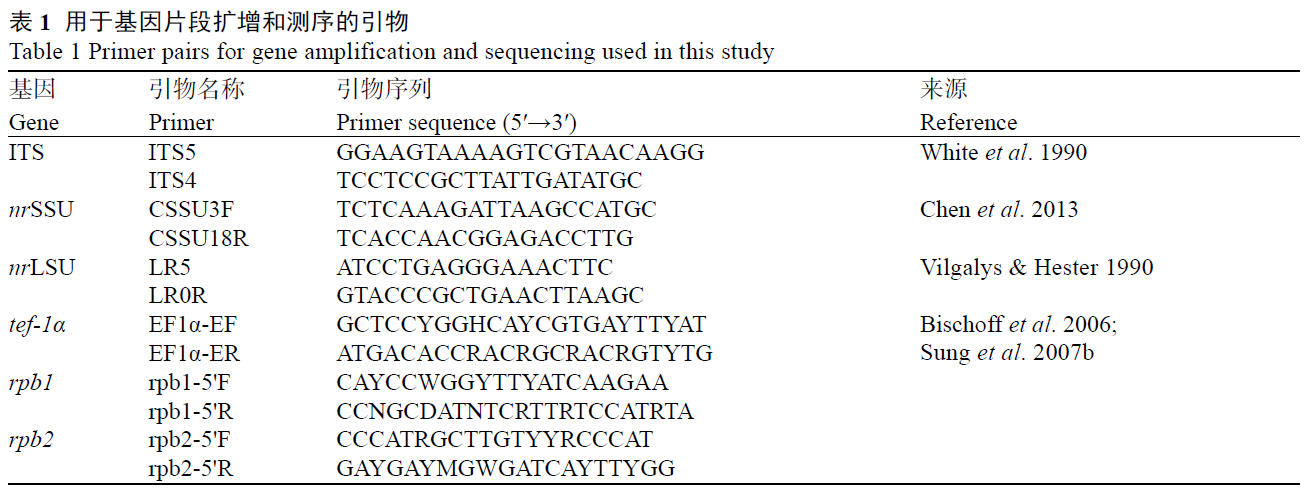
对标本开展DNA 提取和基因片段PCR 扩增及测序。分别使用真菌基因组DNA 提取试剂盒(离心柱型,TransGen Biotech)提取标本菌核和子座部分的DNA。DNA 提取完成后,利用PCR扩增其ITS (internal transcribed spacer)、nrSSU (small subunit ribosomal RNA)、nrLSU (large subunit ribosomal RNA) 、tef-1α (transcription elongationfactor-1 alpha)、rpb1 (largest subunits of RNA polymerase Ⅱ ) 和rpb2 (second largest subunits of RNA polymeraseⅡ)序列,所用引物见表1。所有PCR 反应的总体积为25 μL,其中含有12.5 μL 2× Taq PCR Master Mix (TransGen Biotech),每种引物1.25 μL (10 μmol/L),基因组DNA 1 μL,RNase-Free water 9 μL。扩增程序参考试剂盒说明。使用1.5%琼脂糖胶检测PCR产物,使用EasyPureTM Quick Gel Extraction Kit(TransGen Biotech)进行纯化,在生工生物工程(上海)股份有限公司利用ABI 3700 自动测序仪进行测序。
1.4 多基因分子系统发育分析
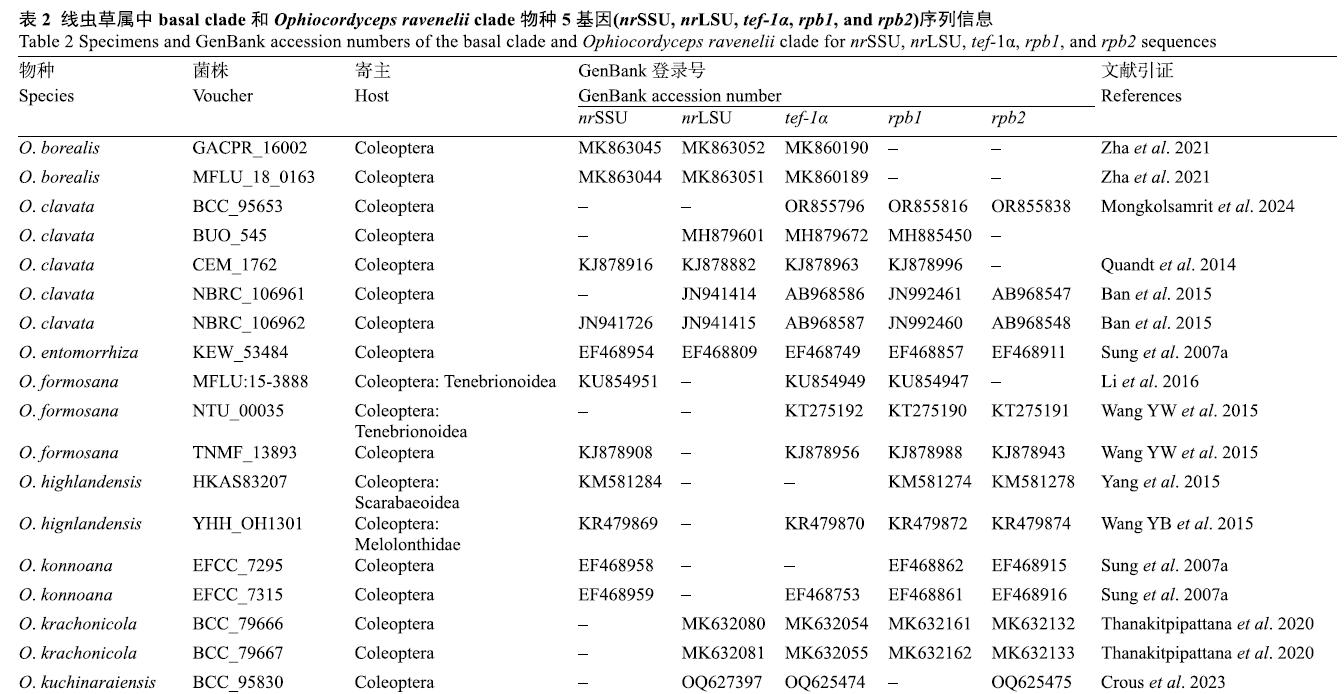
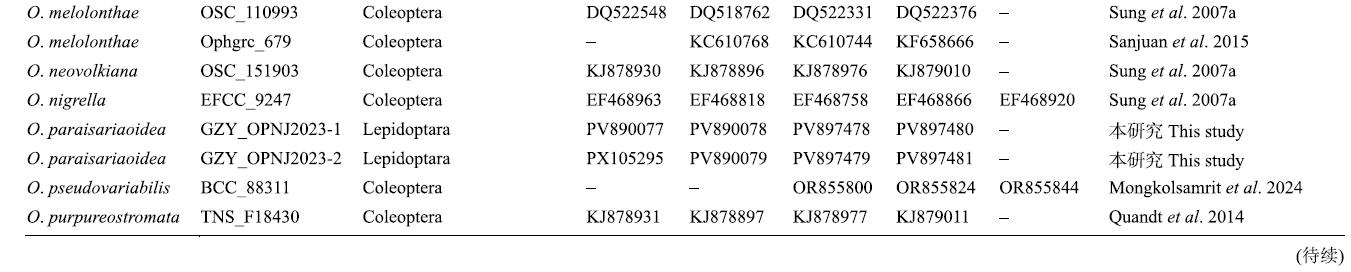
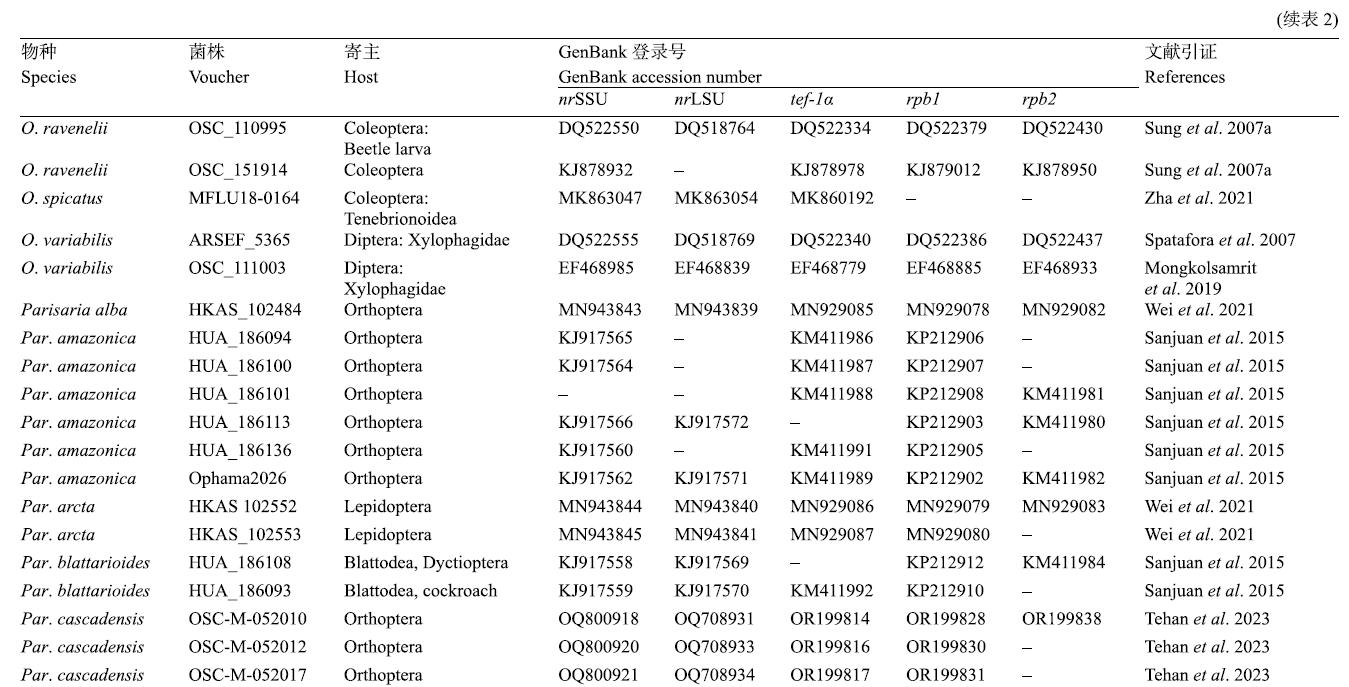
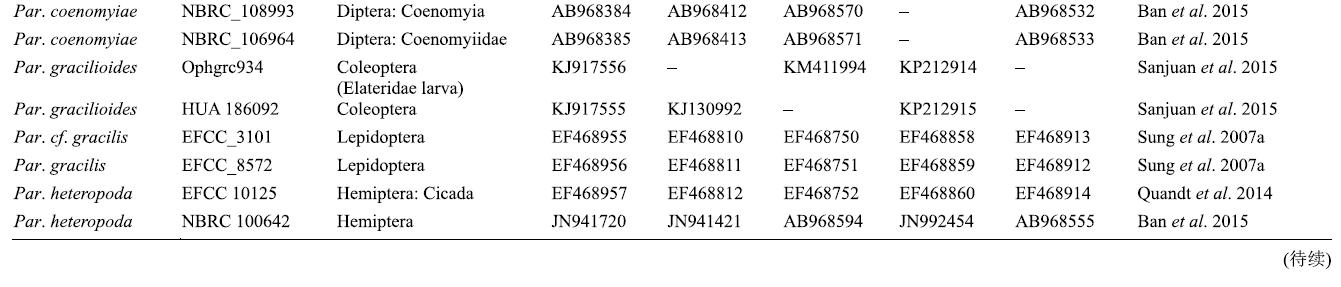
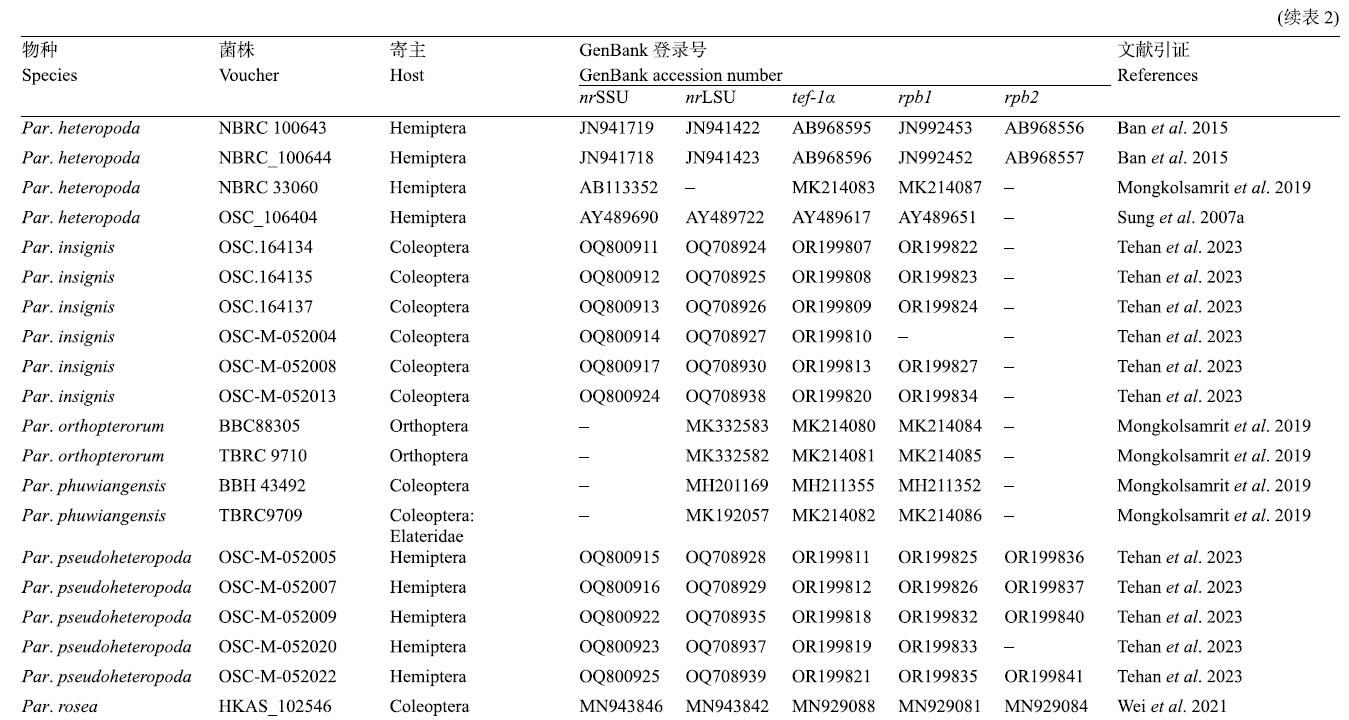
测序结果首先使用MEGA 5 (Tamura et al. 2011)检查测序序列的AB1 峰图,查看测序文件是否为单峰,若存在双峰、套峰等情况,重新优化程序进行PCR 扩增及测序。基于广泛的文献收集及整理,本研究汇总了线虫草属已发表的多基因测序数据,建立了涵盖该属已报道物种的5基因序列数据库(附表1,国家微生物科学教据中心编号NMDCX0002185),并进一步突出与本研究物种相关的近缘类群分类与序列信息(表2)。在不同基因序列的比对中,nrSSU 和nrLSU 比对参数默认,tef-1α、rpb1 和rpb2 去掉内含子区,且比对后利用codon 模式查看序列是否能正常翻译成蛋白质,并避免出现终止子等情况,必要时进行人工纠错。构建该数据库后,我们直接将本研究标本扩增的5 基因序列加入已构建的线虫草属序列库中,形成5 基因(nrSSU、nrLSU、tef-1α、rpb1 和rpb2)数据集合。设置线虫草属近缘属Drechmeria 物种为外类群。比对拼接完成的5 基因序列总长度为4 536 bp,其中nrSSU 1 104 bp、nrLSU 1 011 bp、tef-1α 933bp、rpb1 552 bp,以及rpb2 936 bp。将5 基因序列分为11 个区,分别是Partition 1:nrSSU;Partition 2:nrLSU;Partition 3–5:tef-1α 密码子1–3 位;Partition 6–8:rpb1 密码子1–3 位;Partition 9–11:rpb2 密码子1–3 位。考虑各基因各位点选择压力,以及不同基因最佳模型差异, 使用PartitionFinder 2 (Lanfear et al. 2017)进行分区优化,并获得优化分区及适用模型。运算结果为: Partition 1—nrSSU ; Partition 2—nrLSU ; Partition 3—tef-1α codon1;Partition 4—tef-1α codon2;Partition 5—tef-1α codon3 ; Partition 6—rpb1 codon1、rpb2 codon1;Partition 7—rpb1 codon2;Partition 8—rpb1 codon3、rpb2 codon3;Partition 9—rpb2 codon2。
使用最大似然法(maximum likelihood, ML)和贝叶斯推论运算(Bayesian inference, BI)进行系统发育运算。ML 运算使用RAxML-HPC BlackBox (8.2.12) (Stamatakis 2006)软件,设置Use a mixed/partitioned model 为9,bootstrap=1 000 开展运算,各区替代模型从PartitionFinder 2 中自动输出。BI 运算使用软件Mrbayes 3.2(Ronquist et al. 2012),各分区模型和相关先验参数由PartitionFinder 2 运算获得、自动调取并生成nex 文件。设置mcmc ngen=3×10⁸,以确保系统发育结构的可靠性。
以上两种运算均在系统发育分析平台CIPRES Science Gateway (https://www.phylo.org/portal2/)完成。Raxml 运行结束后获得的一致树(bipartitions tree)和mrbayes 运算完成获得的tre文件使用Figtree 1.6 (http://tree.bio.ed.ac.uk/software/figtree/)查看并编辑。在分析平台(https://www.chiplot.online)进一步优化系统树。将ML的bootstrap 支持率(bootstrap support, BS)和BI的后验概率(posterior probability, PP)同时标注在系统发育树分支上。由于ITS 在线虫草属不同物种中差异较大,考虑到替代饱和及长枝吸引问题,不适宜将ITS 与5 基因数据集进行联合分析,但ITS 对于物种亲缘关系判别特别是近缘物种有较高的分辨率(Dai et al. 2024),因此我们单独利用IT 序列开展系统发育分析。基于BLAST在线比对,下载相关物种的序列,尤其是在5 基因数据集中与本研究物种有较近亲缘关系的物种。使用软件Mrbayes 3.2 (Ronquist et al. 2012)进行运算。我们在运行程序中加入mcmc stoprule=yesstopval=0.005 (通常设置为0.01),以确保系统发育结果更加稳定可靠。

2 结果与分析
2.1 5 基因(nrSSU、nrLSU、tef-1α、rpb1 和rpb2)系统发育分析
我们构建了线虫草属439 个标本的包含210 个已知物种的5 基因系统发育树。结果显示本研究构建的线虫草属系统发育框架与之前的研究结果基本保持一致(Sanjuan et al. 2015;Dai et al. 2024;Xu et al. 2025),但系统发育整体结构框架更加明显,主要形成5 个支系:Ophiocordyceps ravenelii clade、O. sinensis clade、O. unilateralis clade、O. sphecocephala clade 和O. soblifera clade (图1A)。
本研究报道的羽束梗孢状线虫草Ophiocordyceps paraisarioidea 系统位置位于线虫草属基部,基于其特殊的系统发育位置,我们定义该分支为基部分支(basal clade),包含O. paraisarioidea、虫根线虫草O. entomorrhiza (Dicks.) G.H. Sung et al.和黑拟多头束霉Tilachlidiopsis nigra Yakush. & Kumaz.。在该分支内,羽束梗孢状线虫草与另2 个物种系统位置差异显著,支持其作为独立的物种(BS=100, PP=1.0)。
基于BLAST 相似性搜索,利用ITS 序列构建了O. paraisarioidea 及其近缘物种的系统树(图2),结果显示O. paraisarioidea 与其近缘种的关系与5 基因系统树有一定差异,这可能与二者进化速率不一致有关。O. paraisarioidea与O. entomorrhiza 仍处于线虫草属末端,但O.paraisarioidea 与O. entomorrhiza 并不在同一个分支。O. paraisarioidea 与O. ravenelii clade 有较近的亲缘关系,而O. entomorrhiza 则与弯颈霉属Tolypocladium 更近。这种分子层面的接近关系也提示O. paraisarioidea 与O. entomorrhiza可能代表线虫草属中一个较为原始的类群,且可能是线虫草属和弯颈霉属之间的过渡物种。
此外,我们将线虫草物种寄主种类映射至线虫草属系统发育关系中,结果显示,线虫草属不同系统发育分支与寄主类群(节肢动物)形成较为一致的对应关系(图1B),提示线虫草属物种与寄主之间可能存在显著的协同进化模式。
O. paraisarioidea 所在基部分支(basal clade)及近缘分支O. ravenelii clade 寄主为鞘翅目昆虫(仅O. variabilis 例外,寄主为Diptera),本研究描述的O. paraisarioidea 寄主为鳞翅目蛾类幼虫,为线虫草属,尤其是基部类群物种的寄主多样性提供了实例。
2.2 物种分类
羽束梗孢状线虫草 图3 新种 Ophiocordyceps paraisarioidea Y.D. Dai & Ch. X. Chang sp. nov. Fig. 3
MycoBank: MB 859746
Etymology: Paraisaria+oidea, refers to several characters of this species similar to the Paraisaria species.
Holotype: GZY_OPNJ2023-1, China. Yunnan Province: Lanping county, Jinding town (99°32ʹE, 26°41ʹN), on the larva of species of Lepidoptera. July 2023, collected by Yongdong Dai and Dehua Hou (Fig. 3A, 3B). Preserved in the Miao Medicine Museum of Guizhou University of Traditional Chinese Medicine.
Host: the larvae of Lepidoptera, 2.6–4.0 cm × 0.3–0.4 cm.
Stromata: arising from the head of host, 5.0–10.0 cm long, clavate, solid, lignified, usually single, a few with branches (2 to 5) from the middle part, dark brown, with the apex being off-white.
Fertile part: The apex of stromata enlarges into a globose fertile part when mature. 0.5–1.0 cm × 0.2–0.5 cm.
Perithecia: densely arranged on ascocarp, nearly vertically embedded, ellipsoid to cylindrical. 550–710 × 150–230 μm.
Asci: cylindrical, tail slender, some with a narrower neck, thickened in the middle, multi-spored, 150–375 × 3.0–4.75 μm.
Ascus cap: hemispherical, 3.0–4.8 × 1.5–3.4 μm.
Ascospores: filiform, non-disarticulating.150–278 × 1.8–3.3 μm. Septa fusiform, 6.2–13.8 × 1.8–2.5 μm.
Distribution and Habitat: the forest of Lanping in Henduan Mountains, Yunnan, southwest of China.
Additional specimens examined: GZY_OPNJ2023-2,-3...-8 (7 samples) (Fig. 3A). Yunnan Province: Lanping county, on larva of species of Lepidoptera, burried in soil, July 2023, collected by Yongdong Dai and Dehua Hou. GZY_OPNJ2025-1...-10 (10 samples), collected by Chenxin Chang and Yongdong Dai in Lanping, August 2025.
寄生于鳞翅目昆虫幼虫,寄主体长2.6–4.0 cm × 0.3–0.4 cm。子座从寄主头部生出,长 5.0–10.0 cm,呈棍棒状,实心,木质化,通常单生,少数自中部分枝2–5 个,整体深褐色,顶端灰白。成熟时子座顶端膨大形成球形可孕部,大小为0.5–1.0 cm × 0.2–0.5 cm。子囊壳密集排列于子实体表面,近乎垂直埋生,椭圆至圆柱形,550–710 × 150–230 μm。子囊圆柱形,尾部细长,部分具细颈,中部稍增厚,内含多个子囊孢子,150–375 × 3.0–4.75 μm,顶端具半球形子囊帽,3.0–4.8 × 1.5–3.4 μm。子囊孢子丝状,分隔不断裂,隔细胞呈梭形,6.2–13.8 × 1.8–2.5 μm。
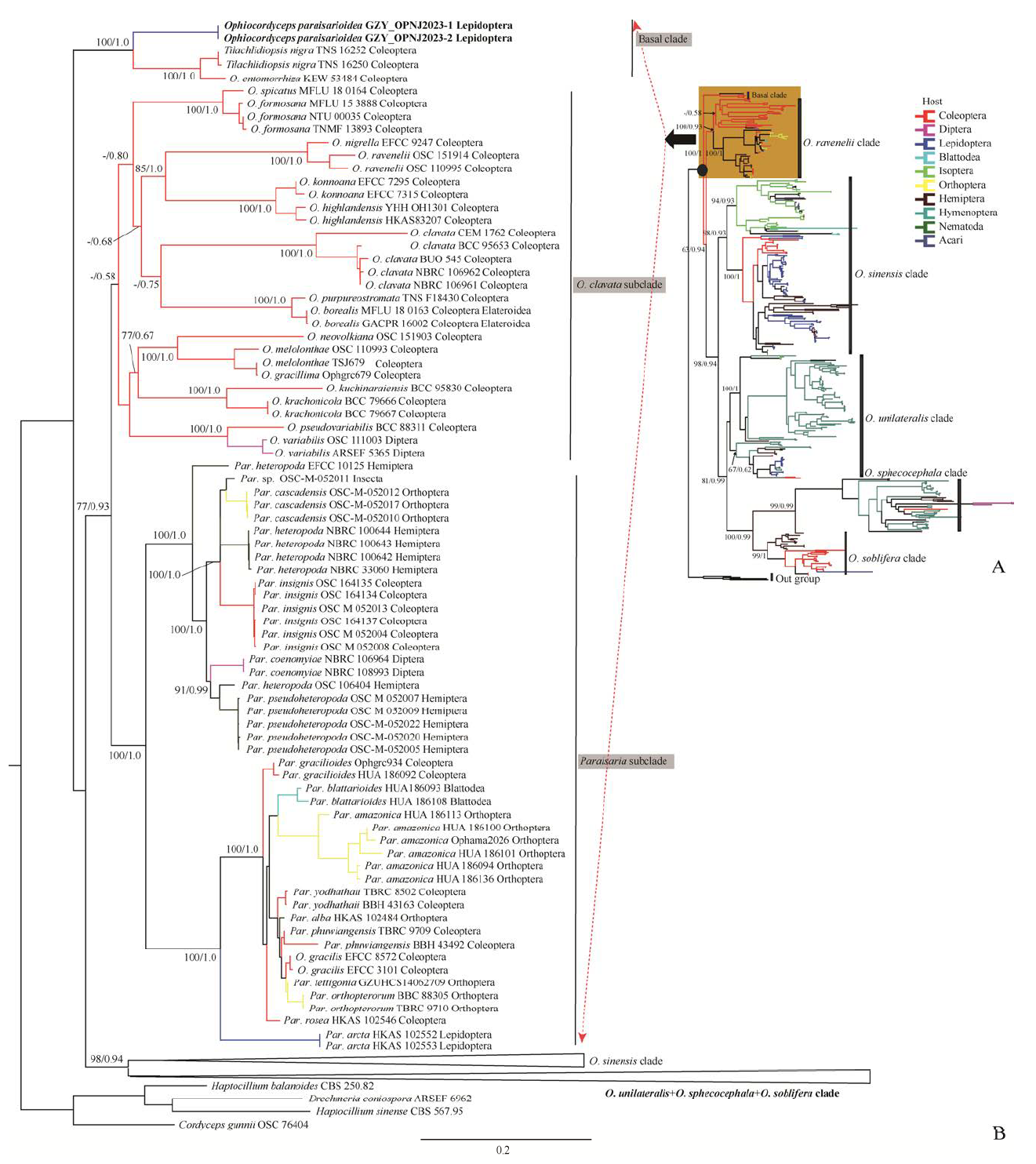
图1 基于5 基因(nrSSU、nrLSU、tef-1α、rpb1 和rpb2)的羽束梗孢状线虫草系统位置及线虫草属Ophiocordyceps 系统发育树 A:Ophiocordyceps 属系统发育树;B:Ophiocordyceps paraisarioidea 及其近缘O. ravenelii clade 物种系统发育树
Fig. 1 The phylogeny of Ophiocordyceps with emphasis on Ophiocordyceps paraisarioidea and its related species based on 5-locus (nrSSU, nrLSU, tef-1α, rpb1, and rpb2) datasets. A: Phylogeny of Ophiocordyceps; B: Phylogeny of Ophiocordyceps paraisarioidea and its related species.
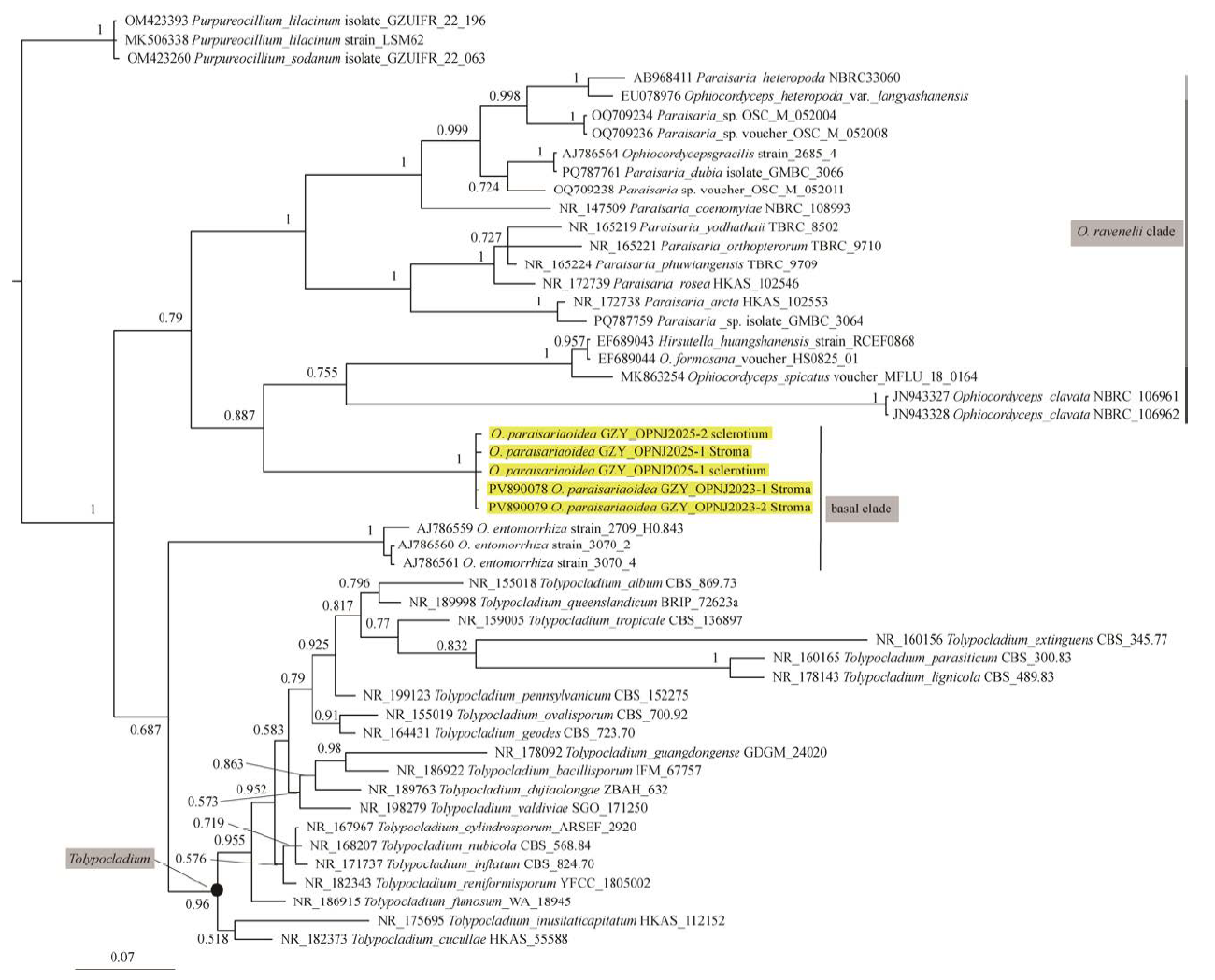
图2 基于ITS 序列的羽束梗孢状线虫草及其近缘种系统发育树
Fig. 2 Phylogeny of Ophiocordyceps paraisarioidea and its related species based on ITS sequences.
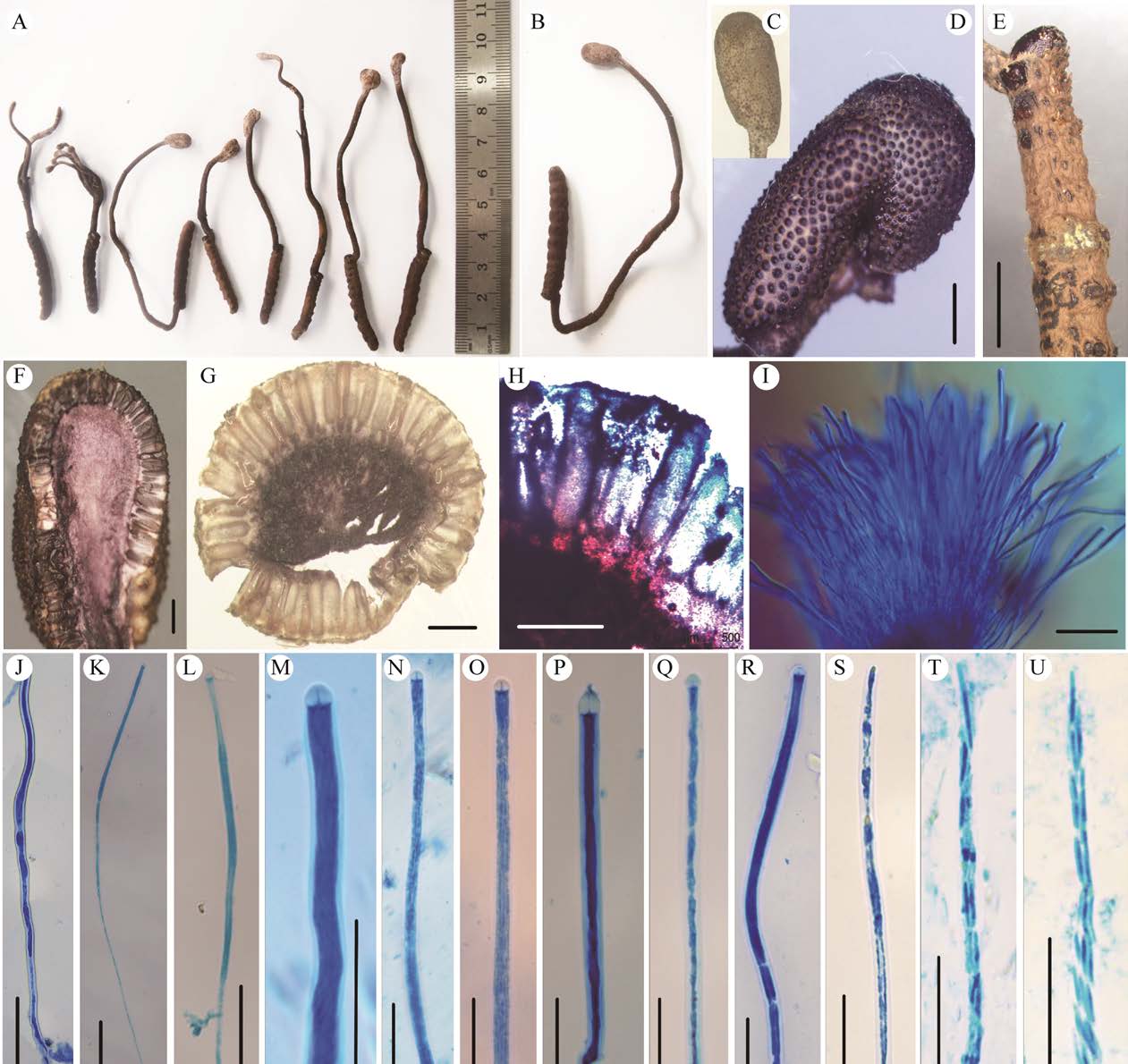

图3 羽束梗孢状线虫草形态特征 A:标本形态特征;B:模式标本GZY_OPNJ2023-1 形态特征;C, D:球状可孕部特征(不同标本);E:寄主形态特征;F–H:埋生子囊壳特征;I–S:单个子囊、子囊帽结构特征;T, U:分隔不断裂的子囊孢子结构特征;标尺:D=1 mm;E=1 cm;F–H=500 μm;I=100 μm;O–Q=50 μm;J–N, R–U=20 μm
Fig. 3 Morphological characteristics of Ophiocordyceps paraisarioidea. A: Morphological characteristics; B: Holotype: GZY_OPNJ2023-1; C, D: The globose fertile part; E: Host morphological characteristics; F–H: Perithecia; I–S: Filiform ascus and ascospore; T, U: Non-disarticulating ascospores. Scale bars: D=1 mm, E=1 cm, F–H=500 μm; I=100 μm; O–Q=50 μm; J–N,R–U=20 μm.
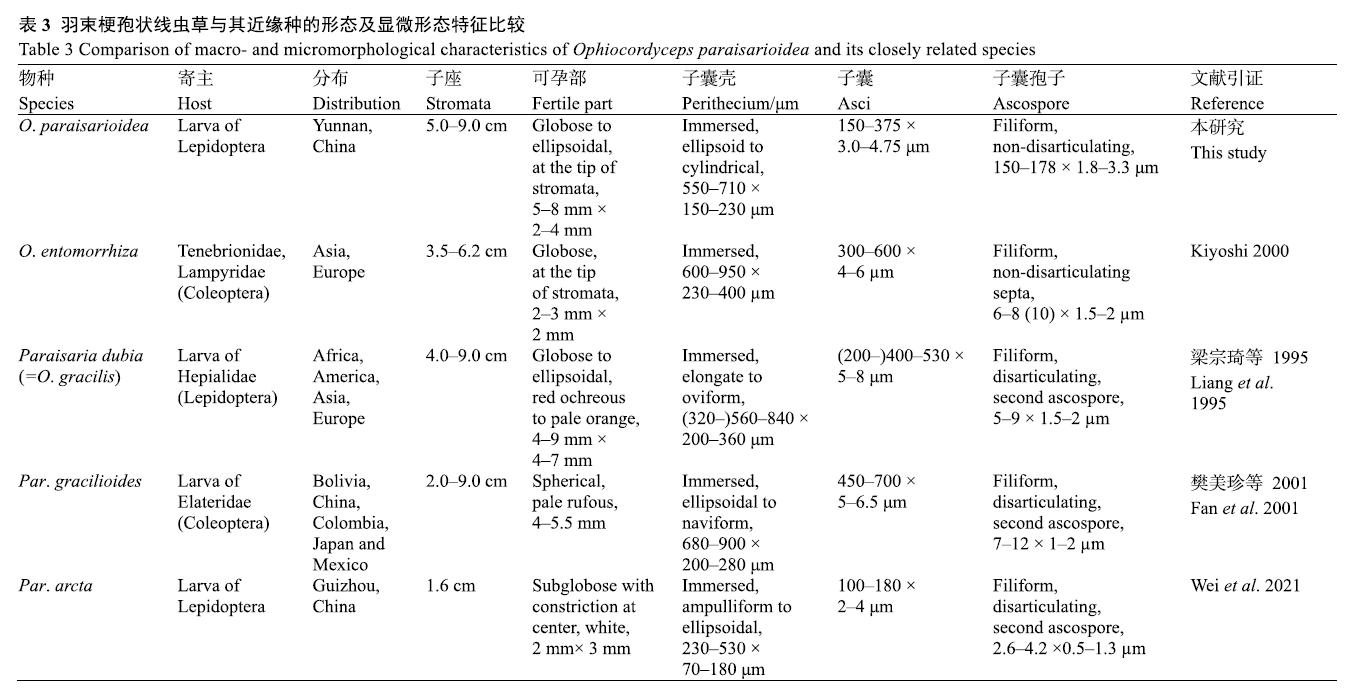
羽束梗孢状线虫草与虫根线虫草在系统发育位置中接近,二者均产生类似于Parisaria-like的球形可孕部顶端,且子囊壳均为埋生,在子座形态上与Paraisaria 属物种相似。但Paraisaria 的子座颜色较浅,而羽束梗孢状线虫草与虫根线虫草子座偏深褐色,且在球形可孕部上的子囊壳顶端形成小突起,而Paraisaria 相对平整无明显突起。另一个显著区别在于Paraisaria 属物种子囊孢子断裂成10 μm 左右的小节,而羽束梗孢状线虫草与虫根线虫草,子囊孢子分隔不断裂(表3)。
羽束梗孢状线虫草与虫根线虫草相比,最显著的差异是前者寄主为鳞翅目一种蛾类幼虫,而后者寄主为鞘翅目幼虫及成虫。此外,O. entomorrhiza 子座偏黑,且容易产生Tilachlidiopsislike孢梗束(Kobayasi 1937;Bałazy 1982),而O. paraisarioidea 子座偏褐色, 未观察到Tilachlidiopsis-like 孢梗束(表3)。