Molecular characterization of a novel alternavirus infecting the entomopathogenic fungus Cordyceps chanhua
Yuxiang Zhang1 · Najie Shi1 · Ping Wang1 · Qiuyan Zhu1 · Guogen Yang2 · Bo Huang1
Received: 7 December 2021 / Accepted: 8 March 2022 / Published online: 12 April 2022
© The Author(s), under exclusive licence to Springer-Verlag GmbH Austria, part of Springer Nature 2022
Abstract:In this study, a novel double-stranded (ds) RNA mycovirus, named Cordyceps chanhua alternavirus 1 (CcAV1), was detected in the entomogenous fungus Cordyceps chanhua in China and characterized. The complete genome of CcAV1 is composed of three dsRNA segments: dsRNA 1 (3,512 bp), dsRNA 2 (2,655 bp), and dsRNA 3 (2,415 bp). Each of the three dsRNAs possesses a single open reading frame (ORF). dsRNA 1 encodes a putative RNA-dependent RNA polymerase (RdRp), and dsRNA 2 and dsRNA 3 encode hypothetical protein 1 (HP 1) and hypothetical protein 2 (HP 2), respectively. The predicted amino acid sequences of the putative RdRp, HP 1, and HP 2 had the highest identity of 66.99%, 49.30%, and 56.91%, respectively, to those of Aspergillus foetidus dsRNA mycovirus. A maximum-likelihood phylogenetic tree based on RdRp amino acid sequences showed that CcAV1 clustered with members of the proposed family “Alternaviridae”. Hence, we propose that Cordyceps chanhua alternavirus 1 is a novel member of the proposed family “Alternaviridae”.
Handling Editor: Ioly Kotta-Loizou.
Yuxiang Zhang and Najie Shi contributed equally to this study and share first authorship.
E-mail Bo Huang:bhuang@ahau.edu.cn
1 Anhui Provincial Key Laboratory of Microbial Pest Control, Anhui Agricultural University, Hefei 230036, China
2 School of Plant Protection, Anhui Agricultural University, Hefei 230036, China
Most of the mycoviruses identified so far have been found to have double-stranded (ds) RNA genomes [1]. The International Committee on Taxonomy of Viruses (ICTV) (https://talk. ictvo nline. org/) has classified dsRNA mycoviruses into eight families, including Amalgaviridae, Chrysoviridae, Megabirnaviridae, Partitiviridae, Polymycoviridae, Quadriviridae, Reoviridae, and Totiviridae, and the genus Botybirnavirus. The establishment of another family, “Alternaviridae”, is still awaiting approval by the ICTV. Members of the proposed family “Alternaviridae” have a genome consisting of at least three dsRNA segments, the largest of which encodes an RNA-dependent RNA polymerase. In 2013, Aspergillus foetidus dsRNA mycovirus was described as a putative member of the proposed genus ‘‘Alternavirus’’ in the proposed family ‘‘Alternaviridae’’ [2]. To date, six mycoviruses have been suggested to be members of this family. However, it has been pointed out that Fusarium graminearum alternavirus 1 (FgAV1) [3] should be regarded as a strain of Fusarium poae alternavirus 1 (FpAV1) [4] because these two isolates infect members of the same genus and have a high degree of similarity in their RdRp sequences, and a similar relationship has been observed between Aspergillus foetidus dsRNA mycovirus (AfVF) and Aspergillus mycovirus 341 (AsV341) [5]. Therefore, the proposed family “Alternaviridae” currently has four members: Alternaria alternata virus 1 (AaV1) [6], AfVF, FpAV1, and Fusarium incarnatum alternavirus 1 (FiAV1) [7, 8]. Despite being grouped together, the number of RNA segments differs between AaV1 (4 segments), AfV-F (4 segments), FiAV1 (3 segments), and FgAV1 (3 segments).
Cordyceps chanhua is a precious traditional medicinal and insecticidal fungus with uses in both medicine and food in China. Taxonomically, because its teleomorph was unknown, this species was long referred to as "Isaria cicadae". With the recent discovery of the teleomorph of this taxon, the name Cordyceps chanhua [9] was proposed and accepted based on molecular data and the principle of one name for one fungus [10]. Over the last three decades, more than 100 Cordyceps chanhua strains from investigative studies of entomopathogenic fungi in China have been isolated and deposited at the Research Center for Entomogenous Fungi of Anhui Agricultural University (RCEF). Here, we report the complete genome sequence of a dsRNA virus with three dsRNA genome segments, derived from the Cordyceps chanhua isolate RCEF6000 and designated as "Cordyceps chanhua alternavirus 1" (CcAV1). Phylogenetic analysis based on RdRp sequences showed that CcAV1 is a novel member of the proposed family ‘‘Alternaviridae’’.
Strain RCEF6000 was isolated from cicada in Anhui Province of China and was identified as Cordyceps chanhua based on its morphological features and molecular data (the sequences of its ITS region and translation elongation factor 1-α gene). The strain was incubated on SDAY medium (1% w/v peptone, 4% w/v dextrose, 0.2% w/v yeast, and 1.5% w/v agar) at 25 °C for 5 days [11]. Approximately 0.5 g of fresh mycelium of each isolate cultured on SDAY was harvested and ground into powder in liquid nitrogen, and the dsRNA was extracted by CF-11 cellulose (Sigma) chromatography [12]. C. chanhua strain RCEF6000 was found to harbor five distinct dsRNAs, approximately 3.5, 2.6, 2.4, 1.8, and 1.6 kb in length, which were named dsRNA 1-5, respectively (Fig. 1A). All gel-purified dsRNAs were sequenced on an Illumina HiSeq 2500 platform at BGI (Shenzhen, China), the clean reads were assembled into approximately 9,500 contigs, and sequence analysis was performed by searching the GenBank database using BLASTx. BLAST and RT-PCR results indicated that strain RCEF6000 was infected by two different dsRNA mycoviruses: a partitivirus (dsRNA 4, dsRNA 5) and an alternavirus (dsRNA 1, dsRNA 2, and dsRNA 3). A cDNA library was constructed using the specific primer 5'- GAT CCA CTA GTT CTA GAG CGGC -3', and the 5′ and 3′ ends of these three dsRNA elements were determined using RNA-ligasemediated rapid amplification of cDNA ends (RLM-RACE) [13]. The primers for amplification of each dsRNA segment are shown in Supplementary data 1 and 2. Each of the PCR products was cloned into the vector pMD18-T (Takara Bio Inc., Kusatu, Shiga) and sequenced at least three times. The results showed that contig 8618 (3,465 bp) corresponded to dsRNA 1, with the highest percent identity (66.99%) to Aspergillus foetidus dsRNA mycovirus, while contig 3757 (2,607 bp) corresponded to dsRNA 2 and contig 3831 (2,359 bp) corresponded to dsRNA 3, with 48.61% and 56.91% amino acid sequence identity, respectively, to Aspergillus foetidus dsRNA mycovirus. Thus, dsRNA 1, dsRNA 2, and dsRNA 3 appear to be the genome segments of a potentially novel dsRNA mycovirus, designated as "Cordyceps chanhua alternavirus 1" (CcAV1) [2, 14].
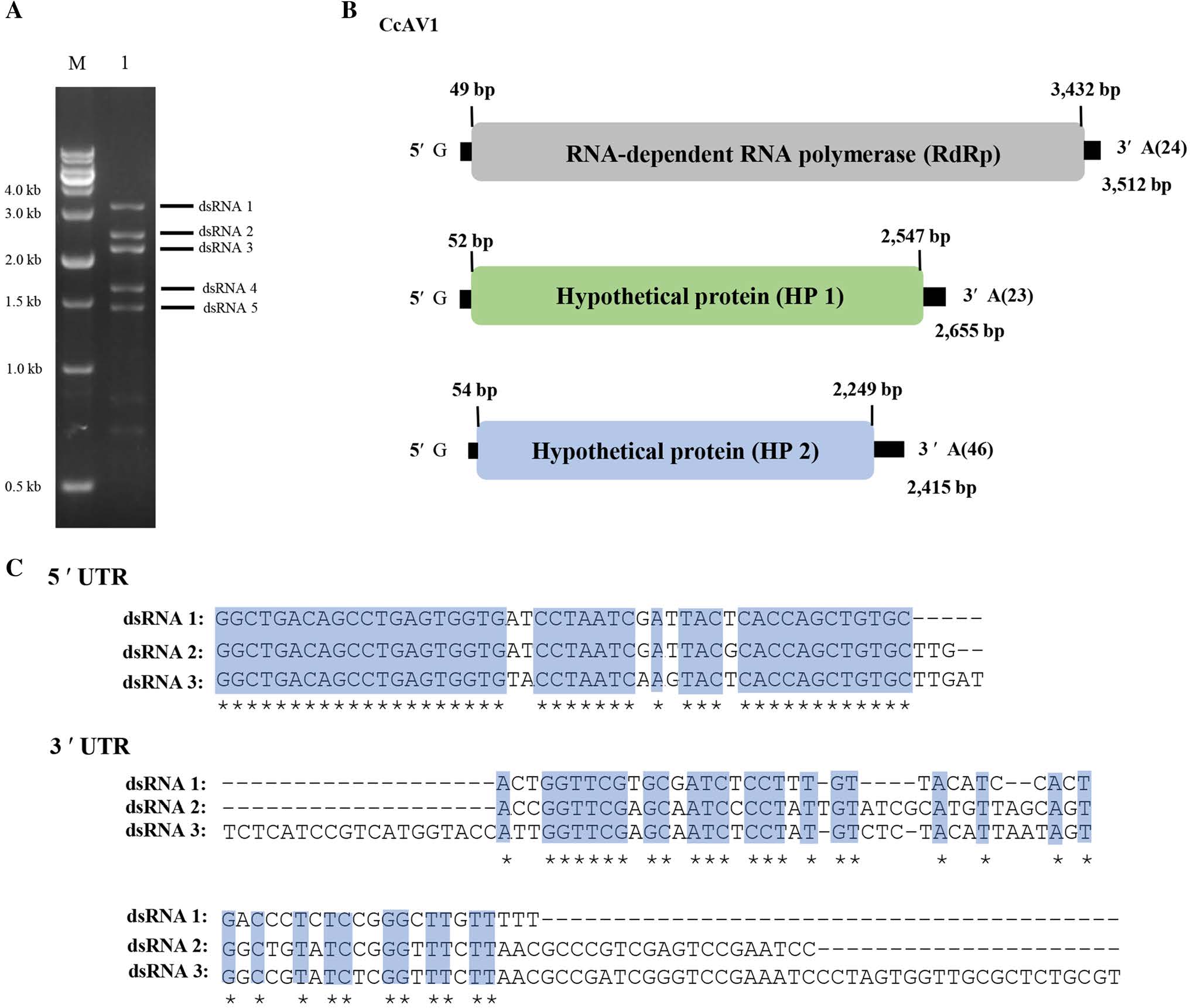
Fig. 1 (A) Electrophoresis of a purified dsRNA extract from C. cicadae strain RCEF6000 in a 1.5% agarose gel. M, DNA marker; lane 1, dsRNA.
(B) Schematic representation of the CcAV1 genome structure.
(C) Conserved sequences of 5′ and 3′ termini of dsRNA 1, dsRNA 2, and dsRNA 3 of CcAV1. “*” indicates a conserved nucleotide.
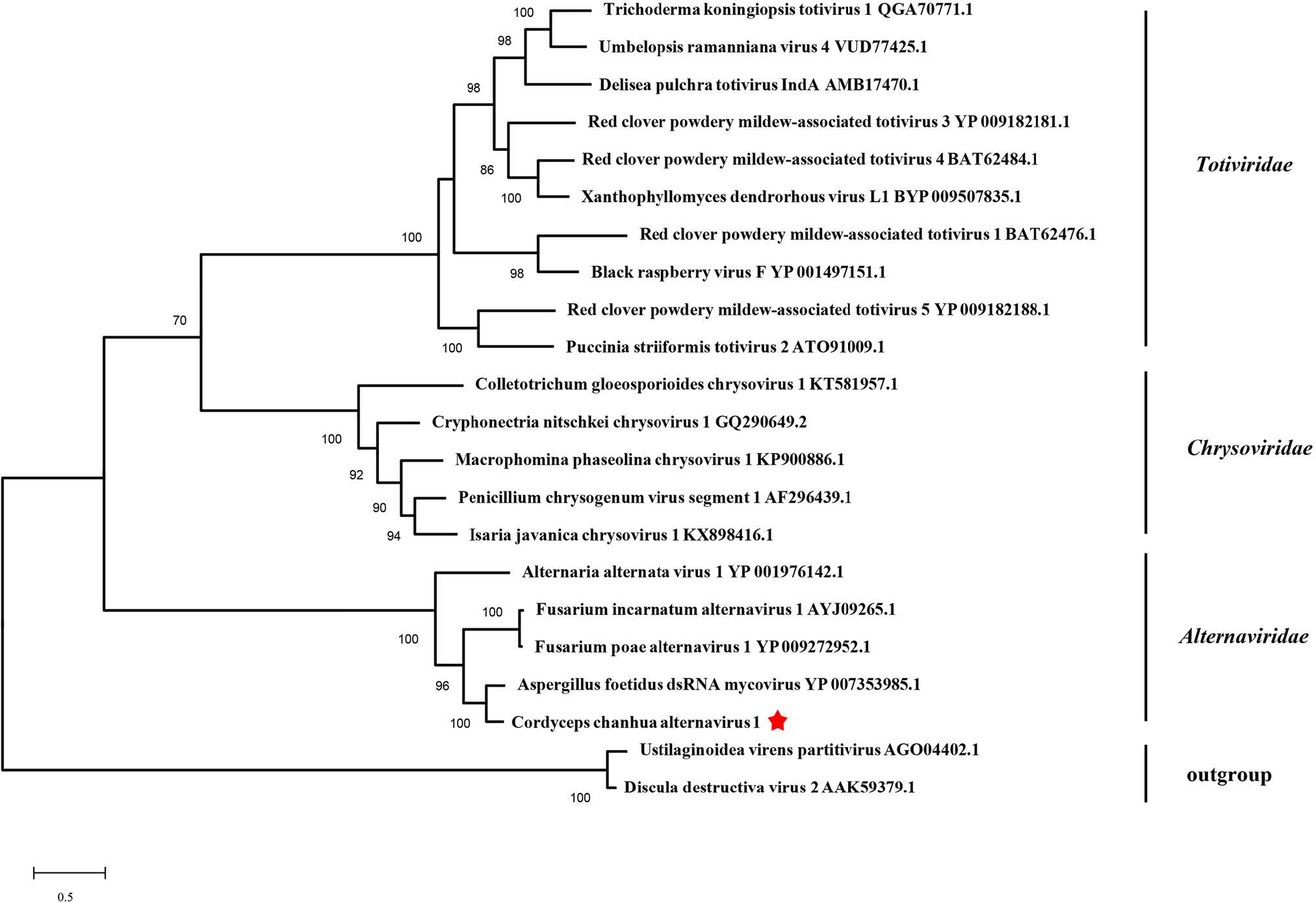
Fig. 2 Maximum-likelihood (ML) phylogenetic tree based on RdRp sequences, constructed in MEGA X using the LG+G+I+F amino acid substitution model. The scale represents 0.5 amino acid substitutions per site, and numbers at the nodes indicate bootstrap values greater than 50 % (1000 replicates).
The complete genome sequence of CcAV1 was deposited in the GenBank database under accession numbers OK481552, OK481553, and OK481554. The putative ORFs of these three dsRNAs were predicted using ORFfinder (https:// www. ncbi. nlm.nih.gov/orffinder/) (Fig. 1B), and the amino acid sequence of the putative RdRp of CcAV1 was aligned with those of other dsRNA viruses using the Multiple Alignment using Fast Fourier Transform (MAFFT) program [15]. A phylogenetic tree was constructed by the maximum-likelihood (ML) method with the LG+G+I+F model and 1000 bootstrap replicates, using MEGA X [16]. The resulting phylogenetic tree was exported to Figtree 1.4.4 (http:// tree. bio. ed. ac. uk/ softw are/figtree/).
The complete genome of CcAV1 is composed of three dsRNA segments: dsRNA 1 (3512 bp), dsRNA 2 (2,655 bp), and dsRNA 3 (2,415 bp) (Fig. 1B). The G+C content of dsRNA 1, dsRNA 2, and dsRNA 3 is 55.4%, 57.1%, and 59.7%, respectively. Each dsRNA contains a single ORF, with dsRNA 1 encoding a 126.41-kDa protein of 1,127 amino acids (aa), which is a putative RNA-dependent RNA polymerase (RdRp), dsRNA 2 encoding a 90.73-kDa hypothetical protein of 831 aa (HP 1), and dsRNA 3, encoding a 78.68-kDa hypothetical protein of 731 aa (HP 2). A conserved domain database (CDD; NCBI) search using the RdRp amino acid sequence of CcAV1 as a query sequence confirmed the presence of the expected eight conserved domains that are found in viral RdRp proteins. Further analysis showed that the triad within domain VI of RdRp has an alanine (ADD) instead of the nearly universally conserved glycine (GDD), supporting the previous suggestion that ADD is a typical feature of this family [17].
The 5' untranslated regions (5'-UTRs) of dsRNA 1, 2, and 3 are 48, 51, and 53 nt in length, respectively. Sequence alignment of the 5' UTRs of the three dsRNA segments of CcAV1 demonstrated that all three dsRNA shared a conserved sequence (GGC TGA CAG CCT GAG TGG TGNNCCT AAT CNANTACNCAC CAG CTG TGC ) (Fig. 1C). A poly(A) sequence present in all three dsRNA segments ranges from 23 to 46 nt in length (Fig. 1B), and the nucleotide sequence identity among these 3'-UTRs is 27.27%, excluding the poly(A) tails (Fig. 1C). A BLASTp search showed that the RdRp, HP 1, and HP 2 of CcAV1 had the highest sequence similarity to the corresponding proteins of AfVF (66.99%, 49.30%, and 56.91%, respectively). In order to determine the taxonomic position of CcAV1, an ML phylogenetic tree based on RdRp amino acid sequences of 21 mycoviruses, including 10 totiviruses, five chrysoviruses, and four alternaviruses was constructed with two partitiviruses as outgroups. The phylogenetic tree showed that CcAV1 grouped in the proposed family ‘‘Alternaviridae’’ with AfVF (Fig. 2). In summary, we propose that CcAV1 is a new member of the proposed family ‘‘Alternaviridae’’ based on phylogenetic analysis, RdRp sequence comparisons, and analysis of conserved motifs. This is the first report of a mycovirus in the proposed family “Alternaviridae” that infects an entomopathogenic fungus.
Supplementary Information The online version contains supplementary material available at https:// doi. org/ 10. 1007/ s00705- 022- 05446-2.
Funding This work was supported by the National Natural Science Foundation of China (Grant no. 32172473) and the Anhui Natural Science Foundation (Grant no. 1908085MC56).
Declarations
Conflict of interest The authors have no conflict of interest.
Ethical approval This article does not contain any studies with human participants or animals performed by any of the authors.
References
1. Wang P, Yang G, Shi N, Huang B (2021) A novel gammapartitivirus from the entomopathogenic fungus Metarhizium brunneum. Arch Virol 166:977–981
2. Kozlakidis Z, Herrero N, Ozkan S, Kanhayuwa L, Jamal A, Bhatti MF, Coutts RH (2013) Sequence determination of a quadripartite dsRNA virus isolated from Aspergillus foetidus. Arch Virol 158:267–272
3. He H, Chen X, Li P, Qiu D, Guo L (2018) Complete genome sequence of a Fusarium graminearum double-stranded RNA virus in a newly proposed Family, Alternaviridae. Genome Announc 6:e00064-e118
4. Osaki H, Sasaki A, Nomiyama K, Tomioka K (2016) Multiple virus infection in a single strain of Fusarium poae shown by deep sequencing. Virus Genes 52:835–847
5. Hammond TM, Andrewski MD, Roossinck MJ, Keller NP (2008) Aspergillus mycoviruses are targets and suppressors of RNA silencing. Eukaryot Cell 7:350–357
6. Wu CF, Aoki N, Takeshita N, Fukuhara T, Chiura HX, Arie T, Kotta-Loizou I, Okada R, Komatsu K, Moriyama H (2021) Unique terminal regions and specific deletions of the segmented double-stranded RNA genome of Alternaria alternata Virus 1, in the proposed Family Alternaviridae. Front Microbiol 12:773062
7. Aoki N, Moriyama H, Kodama M, Arie T, Teraoka T, Fukuhara T (2009) A novel mycovirus associated with four double-stranded RNAs affects host fungal growth in Alternaria alternata. Virus Res 140:179–187
8. Zhang X, Xie Y, Zhang F, Sun H, Zhai Y, Zhang S, Yuan H, Zhou L, Gao F, Li H (2019) Complete genome sequence of an alternavirus from the phytopathogenic fungus Fusarium incarnatum. Arch Virol 164:923–925
9. Li Z, Luan F, Hywel J, Zhang S, Chen M, Huang B, Sun C, Chen
Z, Li C, Tan Y, Dong J (2021) Biodiversity of cordycipitoid fungi associated with Isaria cicadae Miquel II: Teleomorph discovery and nomenclature of chanhua, an important medicinal fungus in China. Mycosystema 40(1):95–107
10. Taylor JW (2011) One Fungus = one name: DNA and fungal nomenclature twenty years after PCR. IMA Fungus 2:113–120
11. Shi N, Yang G, Wang P, Wang Y, Yu D, Huang B (2019) Complete genome sequence of a novel partitivirus from the entomogenous fungus Beauveria bassiana in China. Arch Virol 164:3141–3144
12. Herrero N, Dueñas E, Quesada-Moraga E, Zabalgogeazcoa I (2012) Prevalence and diversity of viruses in the entomopathogenic fungus Beauveria bassiana. Appl Environ Microb 78:8523–8530
13. Coutts RHA, Livieratos IC (2003) A rapid method for sequencing the 5′- and 3′- termini of double-stranded RNA viral templates using RLM-RACE. J Phytopathol 151:525–527
14. Wen C, Wan X, Zhang Y et al (2021) Molecular characterization of the first alternavirus identified in Fusarium oxysporum. Viruses 13(10):2026
15. Katoh K, Rozewicki J, Yamada KD (2019) MAFFT online service: multiple sequence alignment, interactive sequence choice and visualization. Brief Bioinform 20:1160–1166
16. Kumar S, Stecher G, Li M, Knyaz C, Tamura K (2018) MEGA X: molecular evolutionary genetics analysis across computing platforms. Mol Biol Evol 35:1547–1549
17. Gilbert KB, Holcomb EE, Allscheid RL, Carrington JC (2019) Hiding in plain sight: new virus genomes discovered via a systematic analysis of fungal public transcriptomes. PLoS ONE 14(7):e02192
Publisher's Note Springer Nature remains neutral with regard to jurisdictional claims in published maps and institutional affiliations.
Terms and Conditions
Springer Nature journal content, brought to you courtesy of Springer Nature Customer Service Center GmbH (“Springer Nature”). Springer Nature supports a reasonable amount of sharing of research papers by authors, subscribers and authorised users (“Users”), for smallscale personal, non-commercial use provided that all copyright, trade and service marks and other proprietary notices are maintained. By accessing, sharing, receiving or otherwise using the Springer Nature journal content you agree to these terms of use (“Terms”). For these purposes, Springer Nature considers academic use (by researchers and students) to be non-commercial. These Terms are supplementary and will apply in addition to any applicable website terms and conditions, a relevant site licence or a personal subscription. These Terms will prevail over any conflict or ambiguity with regards to the relevant terms, a site licence or a personal subscription (to the extent of the conflict or ambiguity only). For Creative Commons-licensed articles, the terms of the Creative Commons license used will apply.
We collect and use personal data to provide access to the Springer Nature journal content. We may also use these personal data internally within ResearchGate and Springer Nature and as agreed share it, in an anonymised way, for purposes of tracking, analysis and reporting. We will not otherwise disclose your personal data outside the ResearchGate or the Springer Nature group of companies unless we have your permission as detailed in the Privacy Policy.
While Users may use the Springer Nature journal content for small scale, personal non-commercial use, it is important to note that Users may not:
1、use such content for the purpose of providing other users with access on a regular or large scale basis or as a means to circumvent access control;
2、use such content where to do so would be considered a criminal or statutory offence in any jurisdiction, or gives rise to civil liability, or is otherwise unlawful;
3、falsely or misleadingly imply or suggest endorsement, approval , sponsorship, or association unless explicitly agreed to by Springer Nature in writing;
4、use bots or other automated methods to access the content or redirect messages override any security feature or exclusionary protocol;
5、or share the content in order to create substitute for Springer Nature products or services or a systematic database of Springer Nature journal content.
In line with the restriction against commercial use, Springer Nature does not permit the creation of a product or service that creates revenue, royalties, rent or income from our content or its inclusion as part of a paid for service or for other commercial gain. Springer Nature journal content cannot be used for inter-library loans and librarians may not upload Springer Nature journal content on a large scale into their, or any other, institutional repository.
These terms of use are reviewed regularly and may be amended at any time. Springer Nature is not obligated to publish any information or content on this website and may remove it or features or functionality at our sole discretion, at any time with or without notice. Springer Nature may revoke this licence to you at any time and remove access to any copies of the Springer Nature journal content which have been saved.
To the fullest extent permitted by law, Springer Nature makes no warranties, representations or guarantees to Users, either express or implied with respect to the Springer nature journal content and all parties disclaim and waive any implied warranties or warranties imposed by law, including merchantability or fitness for any particular purpose. Please note that these rights do not automatically extend to content, data or other material published by Springer Nature that may be licensed from third parties.
If you would like to use or distribute our Springer Nature journal content to a wider audience or on a regular basis or in any other manner not expressly permitted by these Terms, please contact Springer Nature at
onlineservice@springernature.com