接第一篇
3.3 The systematic concatenated ITS, nrLSU,nrSSU, Rpb1, and Tef1 dataset and phylogeny analysis
Total of 62 sequences of ITS, nrLSU, nrSSU, Rpb1, and Tef1 belonged to order Hypocreales, families Clavicipitaceae (served as referent data), and 2 sequences belonged to order Hypocreales, genus Verticillium (served as outgroup) were collected from Genbank and listed in Table 3 and T011 sequence. According to 62 sequences, they were divided into three families (Cordycipitaceae, Clavicipitaceae,Ophiocordycipitaceae), and each family was also divided intro genus, including Cordycipitaceae (genus: Cordyceps, Beauveria, Simplicillium, Lecanicillium), Clavicipitaceae(genus: Claviceps, Balansia, Pochonia, Conoideocrella,Metapochonia, Metarhizium), and Ophiocordycipitaceae(genus: Drechmeria, Ophiocordyceps). The best-fit model of DNA evolution for the analyses was obtained using the jModelTest2. Results are shown from General Time Reversible and Gramma distributed with invariant Sites (G + I) with the following parameters: parameters =109, BIC = 42628.811, lnL = −20671.999, (+I) = 0.450, (+G) =0.466, R = 2.186, f(A) = 0.246, f(T) = 0.221, f(G) = 0.257, f(C)= 0.276, r(AT) = 0.030, r(AC) = 0.040, r(AG) = 0.110, r(TA) =0.030, r(TC) = 0.260, r(TG) = 0.040, r(CA) = 0.040, r(CT) =0.220, r(CG) = 0.050, r(GA) = 0.100, r(GT) = 0.330, and r(GC) = 0.040. This model was used to construct phylogenetic trees using maximum likelihood from concatenated data set. Phylogenetic analysis was presented in Figure 2. As the results, the Clavicipitaceae formed a strong monophyletic group and separated from the out group. All the species in our dataset formed threes clades that were previously reported. According to T011, the T011 multiple gene sequences (ITS, nrLSU, nrSSU, Rpb1, and Tef1) formed a group with referent sequences of C. cicadae, Cordyceps sp., and Isaria sp., belonged to the clade Clavicipitaceae, subclade Cordyceps, with the high supported bootstrap values: 100, 100, 100 for NJ, MP, ML method (Figure 2,blanket). Therefore, the molecular identification indicated that T011 was identified as I. cicadae (anamorph of C. cicadae).
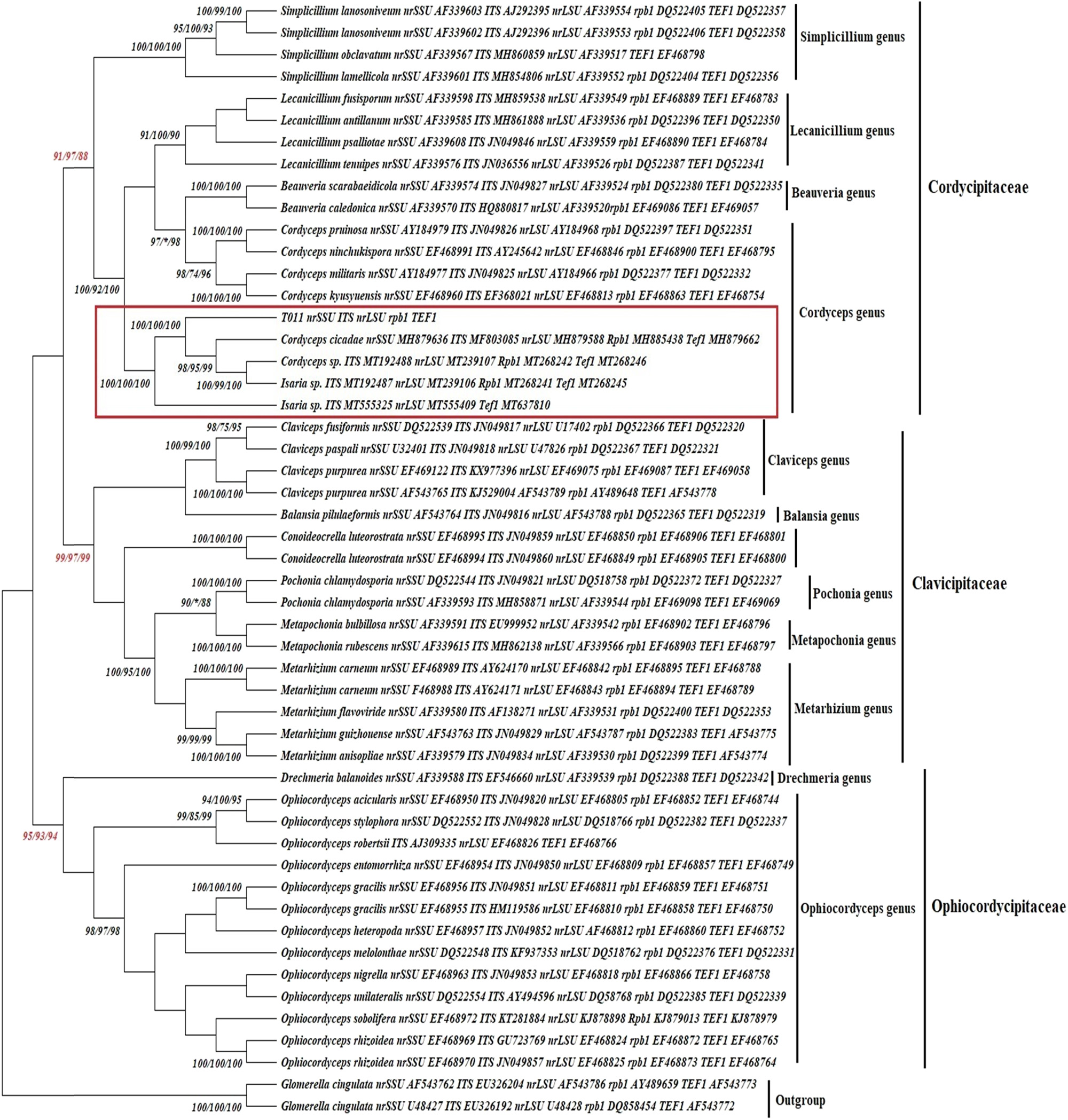
Figure 2: Phylogenetic relationships among T011 and concatenated data set based on the analysis of ML method with bootstrap 1,000. The support values associated with each internal branch correspond to NJ, MP, ML method, indicating that T011 was closely related to C. cicadae (Teleomorph of I. cicadae).
4 Discussion
Morphology analysis indicated that T011 is Isaria cicadae,belonged to the family of Cordycipitaceae. Based on the morphology analysis, our specimen T011 shared the common features of Isaria cicadae Miq. Bull. Sci. phys. nat. Néerl.:85 (1838) [17], including: (1) specimen grew in the soil, (2) parasite on the nymph of cicada, (3) synnemata were simple and erect with branching, white to cream, (4) colonies were floccose, white and turned into powdery with age, and (5)conidia: hyaline to white, cylindrical, large (T011: 4.7–6.5 ×2.6–3.1 mm, and referent: 3.5–8.0 × 1.5–3.5 μm).
To confirm the authenticity of T011 as Isaria cicadae, the construction of ITS, nrLSU, nrSSU, Rpb1, and Tef1-based phylogeny was performed. According to Mitchell et al. (1995), they suggested that molecular phylogenetic approaches to fungal evolution have proved valuable information toward the goals of understanding the relationship among the specific fungal groups [8]. Additionally,the use of fungal molecular data, including ITS,nrLSU, nrSSU, Rpb1, and Tef1, for the identification of fungi ushered in a new era of molecular phylogenetic sequence identification in kingdom Fungi [1,12]. In this study, the combination of ITS, nrLSU, nrSSU, Rpb1, and Tef1 genes were applied to strongly strengthen the identification of T011, which was classified as I. cicadae.According to phylogenetic analysis, phylogenetic analysis of ITS, nrLSU, nrSSU, Rpb1, and Tef1 yielded consistent topology in different taxa of Clavicipitaceae. The phylogenetic position of T011 was obtained and accepted at subclade level: Cordyceps. Notably, within this clade,the highly supported monophyletic group with referent C. cicadae was obtained with high bootstrap value (Bootstrap>95: NJ: 100; MP: 100; ML: 100) and separated this group from other referent taxon in subclade Cordyceps, such as C. ninchukispora, C. pruinosa, and C. kyusyuensis.Additionally, T011 formed the groupwith referent C. cicadae,Cordyceps sp., and Isaria sp. Among them, Cordyceps sp. and Isaria sp. were proposed using the ancient Chinese name“chanhua” (Cordyceps chanhua) [25]. Therefore, based on the phylogenetic analysis, the T011was identified as the Isaria cicadae (anamorph of C. cicadae), whichwas strongly similar to Cordyceps chanhua. Therefore, we have successfully applied the phylogenetic analyses based on the concatenated dataset to strengthen the identification of T011, collected in the local coffee garden in Ea Knop Town – Ea Kar District, as I. cicadae (anamorph of C. cicadae).
5 Conclusion
We have successfully applied the phylogenetic analysis of multiple genes of ITS, nrLSU, nrSSU, Rpb1, and Tef1 to demimit sample T011, which was collected in Ea Knop Town – Ea Kar District, Đak Lak Province, was strongly supported as Isaria cicadae (anamorph of C. cicadae),which was similar to our preliminary identification. This is the first molecular record of Isaria cicadae in Vietnam.
Acknowledgments: We express our special thanks to National Foundation For Science and Technology Development (NAFOSTED), Vietnam, and Ho Chi Minh City Open University for the genuine support throughout this research work.
Funding information: The research was funded by National Foundation For Science and Technology Development
(NAFOSTED): 106-NN.06.2015.44, Vietnam, and Ho Chi Minh City Open University under the grant number E2019.06.3.Conflict of interest: The authors state no conflict of interest.
Data availability statement: The datasets generated during and/or analyzed during the current study are available from the corresponding author on reasonable request.
References
[1] Bruns TD, White TJ, Taylor JW. Fungal molecular systematics.Annu Rev Ecol Evol Syst. 1991;22:525–64.
[2] Castlebury LA, Rossman AY, Sung G-H, Hyten AS, Spatafora JW.Multigene phylogeny reveals new lineage for Stachybotrys chartarum, the indoor air fungus. Mycol Res.2004;108:864–72.
[3] Hsu JH, Jhou BY, Yeh SH, Chen YI, Chen CC. Healthcare functions of Cordyceps cicadae. J Nutr Food Sci. 2015;5:432.doi: 10.4172/2155-9600.1000432.
[4] Kobayasi Y, Shimizu D. Monographic studies of Cordyceps 2:group parasitic on Cicadae. Bull Natl Sci Mus.1963;6:286–314.
[5] Li L, Zhang T, Li C, Xie L, Li N, Hou T, et al. Potential therapeutic effects of Cordyceps cicadae and Paecilomyces cicadae on adenine-induced chronic renal failure in rats and their phytochemical analysis. Drug Design Dev Ther. 2018;13:103–17.doi: 10.2147/DDDT.S180543.
[6] Liu T, Liu Z, Yao X, Huang Y, Qu Q, Shi X, et al. Identification of cordycepin biosynthesis-related genes through de novo transcriptome assembly and analysis in Cordyceps cicadae. R Soc Open Sci. 2018;5(12):181247. doi: 10.1098/rsos.181247.
[7] Luangsa-ard JJ, Hywel-Jones NL, Manoch L, Samson RA. On the relationships of Paecilomyces sect. Isarioidea species. Mycol Res. 2005;109(Pt 5):581–9. doi: 10.1017/s0953756205002741.
[8] Mitchell JI, Roberts PJ, Moss ST. Sequence or structure: a short review on the application of nucleic acid sequence information to fungal taxonomy. Mycologist. 1995;9:67–76. doi: 10.1016/S0269-915X(09)80212-7.
[9] Olatunji OJ, Feng Y, Olatunji OO, Tang J, Ouyang Z, Su Z.Neuroprotective effects of adenosine isolated from Isaria cicadae against oxidative and ER stress damages induced by glutamate in PC12 cells. Environ Toxicol Pharmacol.2016;44:53–61. doi: 10.1016/j.etap.2016.02.009.
[10] Paterson RR. Cordyceps: a traditional Chinese medicine and another fungal therapeutic biofactory? Phytochemistry.2008;69(7):1469–95. doi: 10.1016/j.phytochem.2008.01.027.
[11] Prayook S, Siripuk S, Panida L. First report of Cordyceps sp. isolated from Cicada in Northeastern Thailand and their characterizations.J Biol Sci. 2013;13:587–95. doi:10.3923/jbs.2013.587.595.
[12] Raja HA, Miller AN, Pearce CJ, Oberlies NH. Fungal identification using molecular tools: a primer for the natural products research community. J Nat Products. 2017;80(3):756–70.doi: 10.1021/acs.jnatprod.6b01085.
[13] Rehner S. Primers for elongation factor 1-a (EF1-a). Beltsville,MD, USA: Insect Biocontrol Laboratory USDA, ARS, PSI; 2001.p. 4. 1p. Available online: http://ocid.NACSE.ORG/research/deephyphae/EF1primer.pdf.
[14] Shi Z, Pan HJ, Fan LF. Advances in research of polysaccharides in Cordyceps species. Food Technol Biotechnol.2009;47(3):304–12.
[15] Sun YF, Sun Y, Wang ZA, Han RL, Lu HF, Zhang JL, et al. Isaria Cicadae conidia possess antiproliferative and inducing apoptosis properties in gynaecological carcinoma cells. Mycology.2017;8(4):327–34. doi: 10.1080/21501203.2017.1386243.
[16] Sung GH, Hywel-Jones NL, Sung JM, Luangsa-Ard JJ,Shrestha B, Spatafora JW. Phylogenetic classification of Cordyceps and the clavicipitaceous fungi. Stud Mycol.2007;57:5–59. doi: 10.3114/sim.2007.57.01.
[17] Vilgalys R, Hester M. Rapid genetic identification and mapping of enzymatically amplified ribosomal DNA from several Cryptococcus species. J Bacteriol. 1990;172:4238–46.doi: 10.1128/jb.172.8.4238-4246.1990.
[18] Vilgalys R, Hester M. Rapid genetic identification and mapping of enzymatically amplified ribosomal DNA from several Cryptococcus species. J Bacteriol. 1990;172:4238–46.doi: 10.1128/jb.172.8.4238-4246.1990.
[19] Weng SC, Chou CJ, Lin LC, Tsai WJ, Kuo YC. Immunomodulatory functions of extracts from the Chinese medicinal fungus Isaria cicadae. J Ethnopharmacol. 2002;83:79–85. doi: 10.1016/
s0378-8741(02)00212-x.
[20] White TJ, Bruns T, Lee S, Taylor J. PCR protocols. San Diego: Academic Press, Inc; 1990. p. 315–22. doi: 10.1016/B978-0-12-372180-8.50042-1.
[21] Xiao JH, Zhong JJ. Secondary metabolites from Cordyceps species and their antitumor activity studies. Recent Pat Biotechnol. 2007;1(2):123–37. doi: 10.2174/187220807780809454.
[22] Xie H, Li X, Chen Y, Lang M, Shen Z, Shi L. Ethanolic extract of Cordyceps cicadae exerts antitumor effect on human gastric cancer SGC-7901 cells by inducing apoptosis, cell cycle arrest and endoplasmic reticulum stress. J Ethnopharmacol.2019;231:230–40. doi: 10.1016/j.jep.2018.11.028.
[23] Zeng WB, Yu H, Ge F, Yang JY, Chen ZH, Wang YB, et al.Distribution of nucleosides in populations of Cordyceps cicadae. Molecules. 2014;19(5):6123–41. doi: 10.3390/molecules19056123.
[24] Zhang CB, Wang YL, Yi M, Dong DC, Su XQ. Identification and phylogenetic analysis of the strain isolated from infected Platylomia pieli in Mopan Mountain, Tianwang Town, Jiangsu province. Guangdong Agric Sci. 2013;40:152–4.
[25] Li ZZ, Luan FG, Hywel-Jones Nigel L, Zhang SL, Chen MJ,Huang B, et al. Biodiversity of cordycipitoid fungi associated with Isaria cicadae Miquel II: teleomorph discovery and nomenclature of chanhua, an important medicinal fungus in China. Mycosystema. 2021;40(2):1–12.