A NEW REPORT ON CORDYCEPS CICADAE FROM WESTERN GHATS, INDIA
P.H.Bagam
Mycology and Plant Pathology Laboratory, Department of Botany, Shivaji University, Kolhapur. 416 004 (M. S.) India.
V.V.Bhosale
Mycology and Plant Pathology Laboratory, Department of Botany, Shivaji University, Kolhapur. 416 004 (M. S.) India.
S.S.Kamble
Mycology and Plant Pathology Laboratory, Department of Botany, Shivaji University, Kolhapur. 416 004 (M. S.) India.
A.B.Magdum
Department of Botany, Shivaji University, Kolhapur. 416 004 (M. S.) India.
S.A.Momin
Department of Botany, Shivaji University, Kolhapur. 416 004 (M. S.) India.
M.S.Nimbalkar
Department of Botany, Shivaji University, Kolhapur. 416 004 (M. S.) India.
A.A.Bhosale,
Mahatma Phule Krishi Vidyapeeth (Agriculture University), Rahuri
Dist.- Ahmednagar (M. S.) India, Email: bagampady@gmail.com
Abstract:
Cordyceps are entomogenous fungi growing on insects. Cordyceps cicadae is a highly valued traditional Chinese medicine (TCM) that has been used in China for over 1,600 years. C. cicadae appears to have a wide range of healthcare functions. In India, various Cordyceps species have been reported viz, Cordyceps sinensis (Berk.) Sacc. (1878), Cordyceps militaris(L.) Fr. (1818), Cordyceps natansPat.,Bull. 1887. Cordyceps cicadae were collected in the Manoli waterfall area, Amba reserve forest Kolhapur. The specimens were collected during the rainy season (July-Sep 2020) and deposited at Herbarium AMH NO.10281 National Fungal Culture Collection of India (NFCCI), Agharkar Research Institute, Pune, India. Cordyceps cicadae were isolated from the Cicadae insect Cryptotympana atrata(Fabricius, 1775). It differs from other Cordyceps species by its host. The species is formally described,illustrated, and compared to other similar species. In the present investigation Cordyceps cicadae, an entomogenous species has been described as a new record inWestern Ghat, India.
Keywords: Entomogenous fungi, Healthcare, Manoli, Cordyceps cicadae, Cicadae insect, NFCCI.
I. Introduction:
The genus Cordyceps is an entomopathogenic fungus that includes more than 400 species worldwide. Cordyceps infect several insects, belonging to the following orders such as Homoptera,Hemiptera, Lepidoptera, Coleoptera, Hymenoptera, and Diptera (Prayooksrivilai, et al,2013). In India 6 species have been reported till a date viz, Ophiocordyceps nutans (Anjali patil,2018), Cordyceps sinensis, Cordyceps militaris, Cordyceps nutans Pat., Cordyceps superficilalis, etc. Cordyceps fruiting bodies have been found medicinal value in Chinese traditional medicines (Yongjun Wang et al 2012).The extracts of Cordyceps fruiting body have been found to possess pharmacological effects,Particularly, in China, Korea, India and Japan(Sun et al.,2017). Cordyceps species have historically been utilized as both food and medicine due to their commercial qualities. Cordyceps species have been used as antitumor, immunomodulating, antioxidant, and pro-sexual agent(Ching et al 2016). Cordyceps militaris, cordyceps soboliferas, cordyceps subssesilus, cordyceps ophioglossoides, are mentioned as medicinal fungi (Ohmori et al,1986, Mizuno, 1999, Wei et al, 2002; Lui et al.,2003, Yue et al.,2008) Fungi infect nymph or larva of Cicadae,P. latypleurakaemferi, Cryptoympanapustulata, and Patylomiapieli (Jui-Hsia et al.2015). Cordyceps species also infected cicada larva found in North and Southern Thailand (Prayook et al,2013). Cicadas are members of the superfamily Cicadoidea and are physically distinguished by their stout bodies, broad head, clear 2embrane wings, and large compound eyes.
II. Material and Methods:
Field collection:
In July to September 2020-2021(2 years), more than 100 specimens were collected from the Manoli waterfall area, Amba reserve forest, Kolhapur, Maharashtra. These specimens were collected in sterile plastic bags and bottles. The collections were stored in cotton balls dipped with 40% formaldehyde and transferred to the Mycology and Plant Pathology Laboratory, Department of Botany, Shivaji University,Kolhapur, India.
Fungal culture, fruiting body, and hyphal observation:
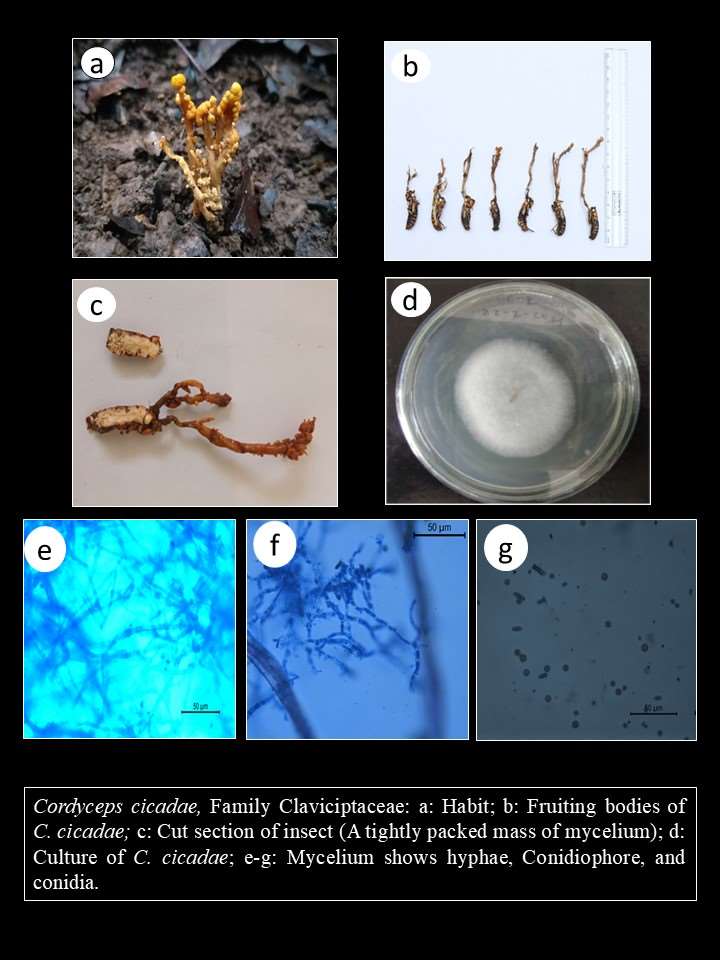
Its fruiting bodies differ from other taxa. The stromata were cylindrical with the average number 3-6 per cicada, 60-90 mm long, and 1.5-2.5 mm wide. Out of 100, 20 specimens were dissected into the small piece(2×2mm). The infected specimen’s larvae were tightly packed mass mycelium, inside solid powder (pic-c) These pieces were cultured on Potato Dextrose Agar medium and incubated at 28-30ºC.After 14 days mycelial colonies were observed. Microscopic observation was carried out under a light microscope using a Cotton blue stain with lactophenol (at 40X ,100X). Mycelium shows hyphae,conidia, and septum (pic- e,f, and g) and specimens deposited at Herbarium AMH NO.10281, at National Fungal Culture Collection of India, Agharkar Research Institute, Pune, Maharashtra, India.
III. Result:
This study showed that these Cordyceps fungi produced fruiting bodies on cicadae larva and white mycelium was aggregated and swiftly evolved into the stroma. The stromata were formed from the mouth, and head of the cicadae larvae (fig-b). The Cordyceps specimens were first isolated from cicadae which are commonly found in a Manoli waterfall area, Amba reserve forest, Kolhapur,Maharashtra. These Cordyceps parasitized cicadae larvae, consuming their internal organs and skeletons in a dense mass of mycelium. It was found that more than 100 Cicadae samples had internal organs consumed. The inside look like solid powder, (fig-c) native fruiting bodies emerged from the cicadae larvae during July-September. The stromata were cylindrical with the average number 3-6 per cicada,60-90 mm long, and 1.5-2.5 mm wide. The stroma was colored brown to pale yellow (fig-a). Cordyceps mycelium grew on PDA plates within 14 days at 28-32 °C, it was white. Hyphal observation determined under light microscopy (at 40X and 100X) the results showed that mycelium shows hyphae were cylindrical in shape, septum and conidia observed (fig-e,f,g). The comparison with previous records shows that the fungus is Cordyceps cicadae (Prayook 2013). The host was identified as Cryptotympana atrata (Fabricius, 1775). It is the first report of Cordyceps cicadae from the Western ghat, India.
IV. Conclusion:
This study was the first report and characterization of Cordyceps species that were found in a Manoli waterfall area, Amba reserve forest, Kolhapur, India. Biological description, cultivation of fruiting body, and comparison with previous work indicated that investigated Cordyceps cicadae species. Finally, this study will be useful for mycologists and fungal taxonomists for further work.
Acknowledgments:
We would like to offer special thanks to the head of the Department of Botany, Shivaji University Kolhapur, to provide lab facilities.
References:
1. Anjali Patil and Snehal Biranje, A Report On Ophiocordyceps Nutans (Pat.) G.H.Sung And Spataphora On Tessartoma Javanica (Thunberg) From Western Ghats, Maharashtra, Aayushi International Interdisciplinary Research Journal, special issue ,pp 636-638, 2018.
2. Sun Yanfang, Michael Wink,Wang Pan,Lu Hongfei,Zhao Hongxin, Liu Hongtao,Wang Shixian,Sun Yang,Liang Zongsuo, Biological characteristics, bioactive components, and antineoplastic properties of sporoderm-broken spores from wild Cordyceps cicadae,Phytomedicine 36:217-228, 2017.
3. Prayook Srivilai, Sripuk Surapron and Panida Louchanwoot, First report of Cordyceps species isolated from Cicada in northeastern Thailand and their characterixzations, Journal of Biological Science, vol 13 issue 7,pp-587-595, 2013.
4. Yongjun Wang,,* Yanbin Guo, Liqin Zhang, and Jia Wu, Characterizations of a new Cordyceps cicada isolate and production of adenosine and cordycepin, Brazilian Journal of Microbiology,43(2), pp 449-455, 2012.
5. Jui-Hsia-Hsu, Bo-Yi Jhou, Shu-Hsing Yeh, Yen –Lien Chen, Healthcare Functions of Cordyceps cicadae. J Nutr Food Sci 5: 432, 2015.
6. Ching-PengChiu, Tsong-LongHwangYouChan, MohamedEl-Shazly, Tung-YingWu, I-WenLo,Yu-MingHsu, Kuei-HungLai, Ming-FengHou, Shyng-ShiouYuan and Yang-ChangWu,Research and development of Cordyceps in Taiwan, Food Science and Human Wellness, Vol 5 issue 4, pp 177-185, 2016.